As India continues to grapple with rising lung-cancer deaths and the absence of a national screening programme, Yashoda Hospital Hitec City has taken a decisive step forward with the launch of an AI-powered Lung Nodule Clinic, a first-of-its-kind model aimed at catching the disease earlier and saving lives.
The clinic uses artificial intelligence to scan routine chest X-rays for subtle abnormalities that often go unnoticed in busy radiology settings. Since its deployment, the system has reviewed more than 17,000 X-rays and flagged nearly 1,000 nodules, including over 130 high-risk cases that required urgent follow-up. Patients identified through AI are then guided through a fast-tracked pathway supported by nurse navigators and a multidisciplinary team of pulmonologists, radiologists and interventional specialists.
By integrating AI-driven detection with advanced diagnostic tools such as radial EBUS, navigational bronchoscopy and cone-beam CT, the clinic offers a comprehensive model designed to close critical gaps in early diagnosis. Hospital leaders believe the approach could be replicated across the country, particularly as India explores more structured screening frameworks.
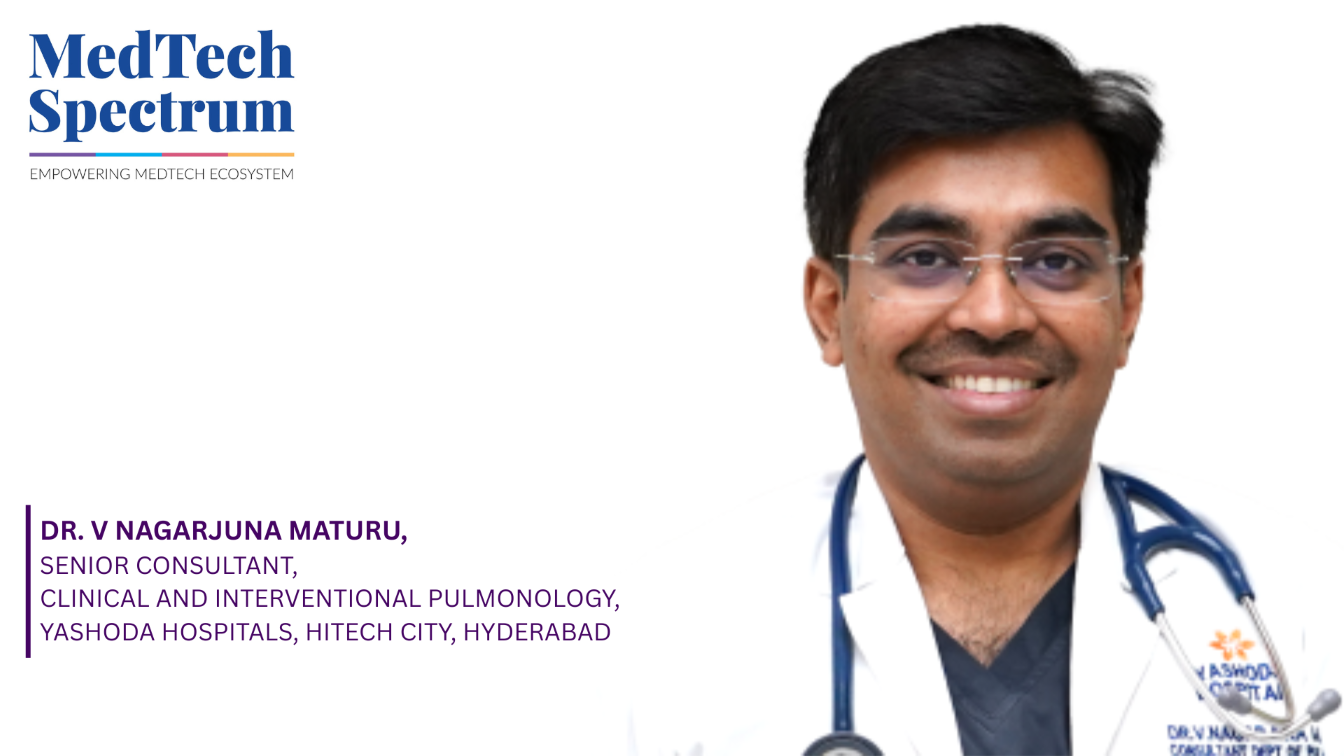
In this interview with MedTech Spectrum, Dr V. Nagarjuna Maturu, Senior Consultant in Clinical and Interventional Pulmonology at Yashoda Hospitals, explains how the AI-led pathway works, its impact so far and why it may represent a blueprint for the future of lung-health care in India.
What inspired the creation of Yashoda Hospital’s AI-enabled Lung Nodule Clinic, especially in a country without a national lung cancer screening program?
In India, nearly one lakh people die of lung cancer every year, largely because we diagnose almost 80 per cent of cases at an advanced stage. Yet we do not have a national lung cancer screening program. That gap was the biggest inspiration. At Yashoda Hospitals Hitec City, we wanted to create a system that didn’t wait for symptoms or formal screening pathways. The AI model helps us identify early radiologic signs on routine chest X-rays — signs that are often subtle and may otherwise be missed or deprioritized. Our goal was to create a structured, technology-driven pathway where every incidental nodule is captured, risk-stratified, and followed up promptly.
How does the AI early-detection pipeline compare with conventional radiology workflows?
Traditionally, nodule detection relies entirely on human review. Small nodules, especially those under 3 cm, can be missed due to their subtle appearance or because of heavy workloads. AI does not experience fatigue like we humans do, and it can pick up minute details more consistently, hence reducing the chances of missing nodules. Our AI system has already analysed more than 17,000 chest X-rays and flagged 960 nodules, including 136 high-risk cases. Seventy-seven patients were then fast-tracked for CT scans and pulmonology review. This creates a seamless, accelerated pipeline with better prioritization, faster escalation, and far fewer delays compared with routine workflows.
How does the multidisciplinary model differentiate between cancer and other nodule-related diseases?
Not all nodules are cancerous; many are caused by tuberculosis, sarcoidosis, or diseases like lymphoma. That is why our model extends beyond simple detection. The pathway begins with AI-driven nodule identification, followed by automated risk stratification. High-risk nodules are then fast-tracked for advanced evaluation. To establish an accurate diagnosis, we use cutting-edge interventional tools such as radial EBUS, navigational bronchoscopy, and cone-beam CT–guided sampling. These technologies help us reach and biopsy even the smallest or hardest-to-access lesions with high precision. This ensures that the underlying cause—whether cancer or another condition—is identified at the earliest possible stage. By combining AI’s ability to detect and risk-stratify nodules with specialist review and advanced biopsy techniques, we achieve a clear, timely, and accurate diagnosis for every patient.
What role does the nurse-navigator model play?
The nurse-navigator is the backbone of this clinic. Once AI flags a nodule, the navigator immediately contacts the patient, explains the finding, schedules CT scans, coordinates pulmonology consultations, and tracks every step until diagnosis. This dramatically reduces drop-offs — a major challenge in India, where awareness of lung nodules is low. By standardizing timelines and documentation, the navigator ensures no patient is lost in the system and every high-risk case is followed through.
How scalable is this AI-powered nodule pathway for other hospitals?
This pathway can be easily used in many hospitals because it fits right into the imaging systems they already have. Any hospital with digital X-ray facilities can adopt it without needing major changes. What’s most important is having clear, standard rules—like how to assess risk, how reports are shared, when follow-ups happen, and how different departments work together. As India builds stronger national screening programs, models like this—supported by AI, guided by healthcare providers, and ready for quick intervention—can become a blueprint for early detection across the country. In simple terms, it’s a system that can grow widely and help save lives by catching problems sooner.
How will AI and advanced interventional tools converge in the future?
AI already helps us detect and prioritise nodules, but we foresee deeper integration — AI-guided bronchoscopy planning, real-time lesion localization, and better prediction of malignancy risk. When combined with tools like radial EBUS, navigational bronchoscopy, and cone-beam CT, AI can make respiratory diagnostics more precise, less invasive, and much faster. This convergence will define the next decade of lung-health care in India.