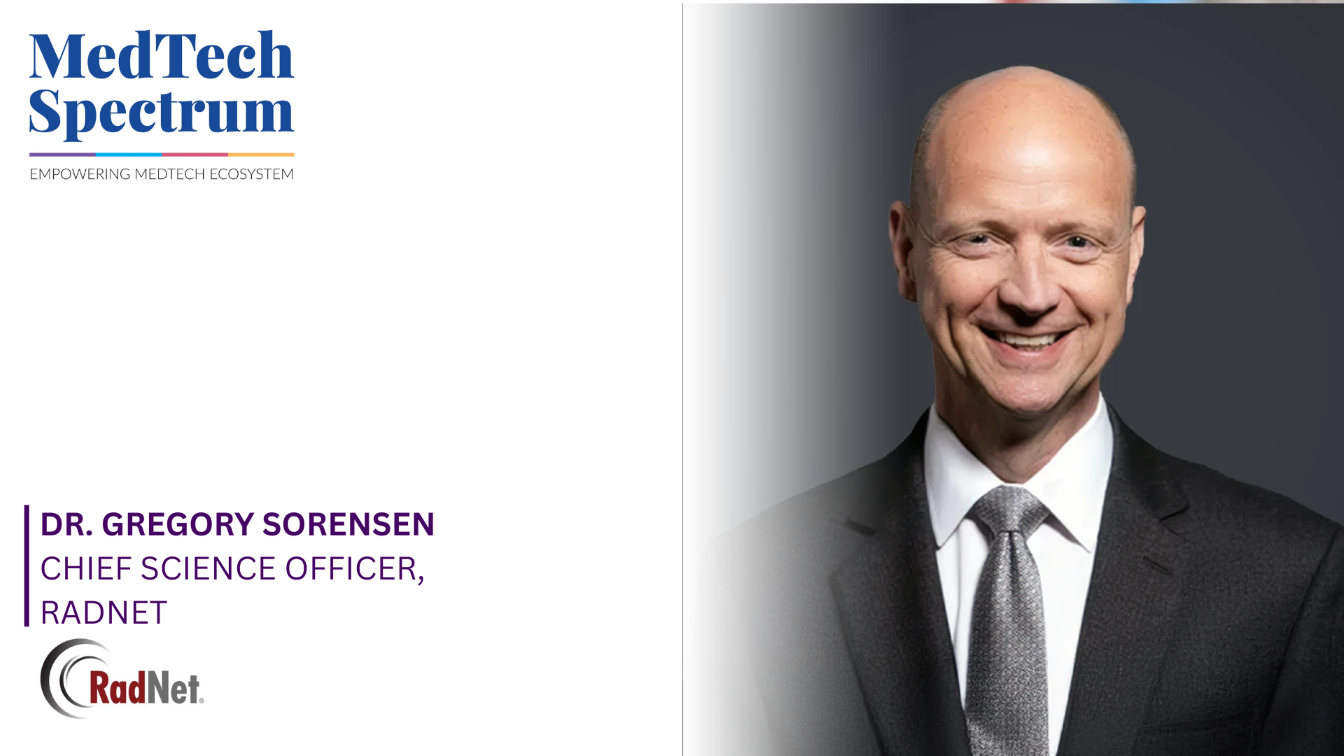
Artificial intelligence is reshaping the future of breast cancer screening and few organisations embody this shift as decisively as RadNet. Following the landmark ASSURE study, which evaluated more than 579,000 women across 109 imaging sites, RadNet has reported a 21.6 per cent increase in cancer detection using its AI-powered screening workflow. At the centre of this transformation is Dr Gregory Sorensen, Chief Science Officer at RadNet, who has been instrumental in bringing AI from pilot-scale promise to real-world clinical impact across the largest outpatient imaging network in the United States.
In this interview with MedTech Spectrum, Dr Sorensen discusses how AI is changing daily screening workflows, the operational challenges of integrating advanced algorithms across a nationwide network, and what the data truly reveals about AI’s ability to reduce long-standing disparities in breast cancer outcomes. He also breaks down the mechanics behind RadNet’s EBCD™ protocol, how AI is reshaping radiologist workload and diagnostic confidence, and what barriers remain before AI-assisted screening can become a national standard of care.
As breast imaging enters a new era defined by data, automation, and equity, Dr Sorensen offers a rare, inside look at how AI is being deployed responsibly and at unprecedented scale to catch cancers earlier and improve patient outcomes across the country.
RadNet has now demonstrated a 21.6 per cent increase in cancer detection using AI-supported screening. From a clinical operations standpoint, how does this change the way your centres approach screening workflows?
It’s very exciting to see such a positive impact from AI, and we absolutely have had to change the way we approach screening workflows to ensure that this is sustainable and available at scale.
One important component of this is making sure the IT infrastructure is in place to make the workflow as straightforward as possible. RadNet simply could not have done this without the DeepHealth Breast Suite software—not just its cancer-detecting AI but the whole suite. After all, if a second physician is going to be brought in as a consultant for just the most important cases, and then reconciliation between the first and second physician must occur, and there’s quite a bit of orchestration that a good IT system can facilitate.
I’m happy to say that now that this software and workflow are in place, the process feels smooth and easy. In fact, it had less impact than when we moved from 2D mammography to 3D mammography.
This study spanned 579,000 women across 109 imaging sites. What operational challenges did RadNet face in standardising AI integration across such a large and diverse network, and how were they overcome?
Implementing AI at scale across 579,583 exams, 109 sites, and 96 radiologists required us to harmonize both technology and workflow across very different practices in California, Delaware, Maryland and New York.
There were several practical challenges:
Technical integration. We had to ensure that the AI system connected smoothly with each site’s DBT platforms, picture archiving and communication systems (PACS), and existing reporting workflows, so radiologists could access AI outputs reliably. The operational challenge centered on integrating AI into varied technical setups across sites without disrupting routine screening practices.
Radiologist training and adoption. We deliberately built in a two-month learning period after deployment so radiologists could adapt to the new workflow—reading with AI overlays, understanding the suspicion categories, and incorporating Safeguard feedback—before we started collecting data for the AI cohort.
Standardizing a “second-look” process. Sites were required to identify breast imaging specialists to act as Safeguard reviewers and to formalize the protocols for escalating and reviewing cases where the AI’s assessment did not align with the initial radiologist read. That process had to be consistent enough to measure, but flexible enough to fit different practice cultures.
We addressed these challenges by building the AI workflow around existing practice patterns—single-reader DBT screening with traditional CAD—and integrating AI into the current reading environment rather than requiring a major platform change. A relatively small fraction of exams (about 8 per cent) ultimately required Safeguard Review, which kept the added workload manageable while still delivering meaningful gains in cancer detection.
The result is a standardized protocol that could be applied across diverse real-world sites without compromising workflow efficiency, safety, or the ability to compare outcomes across cohorts.
The study highlights improvements in detection for Black women and patients with dense breasts. What does this say about AI's potential role in addressing longstanding disparities in breast cancer outcomes?
One of the most important findings from this work is that our novel AI-powered workflow improved detection consistently across subgroups that have historically faced worse outcomes—including Black women and women with dense breasts.
More than 150,000 Black women were included in the ASSURE study, and the AI-enabled workflow increased cancer detection rates for Black, Hispanic, and white non-Hispanic women by roughly 20–22 per cent relative to standard of care, with no observed disparities in cancer detection rate, recall rate, or positive predictive value across racial and ethnic subpopulations.
For women with dense breasts, who face both a higher risk of cancer and greater risk of missed cancers due to masking on mammography, the AI workflow delivered an even larger increase in cancer detection at 22.7 per cent.
Notably, when we adjusted for age, race and ethnicity, breast density, and the interpreting radiologist, we found no significant interaction between AI use and any of these factors—showing that the performance gains were consistent across subpopulations.
Overall, the data suggest that AI can help close gaps in care by delivering specialist-level screening performance in the community settings where most women, including underserved patients, are screened—indicating that AI can be a tool for narrowing disparities rather than widening them. It’s strong evidence that when AI is deployed thoughtfully, with diverse representation built in from the start, it can support more equitable breast cancer screening outcomes.
RadNet’s EBCD™ program uses AI to trigger a second expert review. How has this process changed radiologist workload and diagnostic confidence within your network?
The EBCD™ workflow is designed to focus additional human effort exactly where it’s most needed. In the ASSURE study, all eligible screening exams passed through the AI system, but only those with high AI suspicion and an initial “no cancer present” interpretation were escalated to Safeguard Review by a second breast imaging specialist. In practice, that meant only about 8 per cent of exams underwent a second expert review, and even that review was AI-assisted and therefore not as burdensome.
From a workload perspective, that’s a critical point: we’re not asking radiologists to double-read every exam, as in European double-reading paradigms. Instead, we concentrate specialist attention on a small subset of the highest-risk cases, yet still achieve a 21.6 per cent relative increase in cancer detection overall. The ultimate result: performance improvements comparable to those reported with double reading, but at a fraction of the staffing burden.
For diagnostic confidence, this creates a structured safety net. Generalist radiologists know that if the AI flags a case as high suspicion that they’ve read as negative, a breast imaging specialist will take a second look and provide feedback before the patient is finalized as a “no-recall.” Separate research that we plan to present at RSNA 2025 further evaluated this multistage workflow and showed that it can elevate general radiologists’ performance to that of fellowship-trained breast imagers even at scale, underscoring that the system enhances expertise rather than second-guesses it.
The net effect is that radiologists retain control of the final decision, gain an additional safeguard against missed cancers, and can have greater confidence.
With positive predictive value improving by 15 per cent, how do you expect AI-assisted screening to impact the patient experience, both in terms of reduced anxiety and faster diagnoses?
For patients, the most tangible experience of screening often centers on whether they get “called back” after a mammogram and what that callback ultimately means.
In the ASSURE study, the AI-powered workflow did increase the recall rate modestly, but it remained within American College of Radiology guidelines. At the same time, the positive predictive value of recalls improved by 15 per cent—meaning that when a patient was called back for additional imaging, there was a higher likelihood that cancer would actually be found.
That balance matters. It suggests the additional recalls driven by the AI workflow are more targeted—we’re calling back the right people, not just more people. For patients, that can translate to fewer “false alarm” experiences over time and more meaningful follow-up when it does occur.
Because the workflow is integrated into the interpretation of standard 3D mammography without adding radiation or lengthening the exam, patients don’t experience the AI as a separate procedure. It’s built into a familiar visit. And by increasing cancer detection—particularly in higher-risk groups such as women with dense breasts—the system is designed to surface cancers earlier in their trajectory, which can support timelier diagnosis and treatment.
In short, AI assistance is intended to give patients more value from every screening exam: a similar or slightly higher chance of being called back, but with a substantially higher chance that the callback will matter.
As the largest outpatient imaging provider in the U.S., what do you see as the biggest barriers to nationwide adoption of AI-based screening, and how is RadNet positioned to help overcome them?
Several barriers stand between promising AI technology and true nationwide adoption in breast screening:
Evidence that reflects real-world practice. Historically, much of the early AI literature came from smaller, retrospective studies often based at academic medical centers that don’t reflect how most U.S. women are screened. ASSURE directly addresses that gap by evaluating this novel AI protocol in nearly 580,000 DBT exams across 109 community-based sites, showing a 21.6 per cent increase in cancer detection and a 15 per cent improvement in positive predictive value, with benefits consistent across race, ethnicity and breast density.
Practical integration within a single-reader, resource-limited environment. Double reading is not standard in the U.S., and radiologist shortages make it difficult to simply add more human readers. The multistage workflow featured in the ASSURE study demonstrates that you can achieve cancer detection gains comparable to double reading while sending only ~8 per cent of exams for a second expert review. That’s a model many centers could realistically adopt.
Reimbursement and health equity. Insurance does not currently reimburse for this AI-powered protocol, creating an accessibility barrier for many women. At RadNet, we’re actively working with insurers on reimbursement pathways. Ensuring that payers recognize the demonstrated clinical value of this AI-powered workflow is essential, so access does not depend on a patient’s ability to pay. It is our hope that this technology ultimately has a similar trajectory to that of 3D mammography, which initially required out-of-pocket payments before becoming broadly covered by insurance providers. It’s important to note that during the study period, the AI workflow was provided at no additional charge to avoid selection bias.
RadNet is uniquely positioned to help overcome these barriers because we’ve already moved beyond pilots to large-scale deployment. Since launching EBCD™ nationwide in 2023, we’ve used this AI-powered workflow to screen more than 1.5 million women and detect over 1,000 additional cancers that might otherwise have been missed under standard protocols.
Our role is now twofold: work with our wholly owned subsidiary DeepHealth to build on the evidence—including the Nature Health study and ongoing analyses—and to partner with payers, regulators, and peers to make AI-supported workflows a practical and equitable standard of care.