Artificial intelligence is rapidly transforming diagnostic imaging in India, moving radiology beyond subjective interpretation toward standardised, data-driven clinical decision-making. One area where this shift is especially impactful is paediatric bone age assessment a critical tool in evaluating growth disorders, endocrine conditions, and developmental delays.
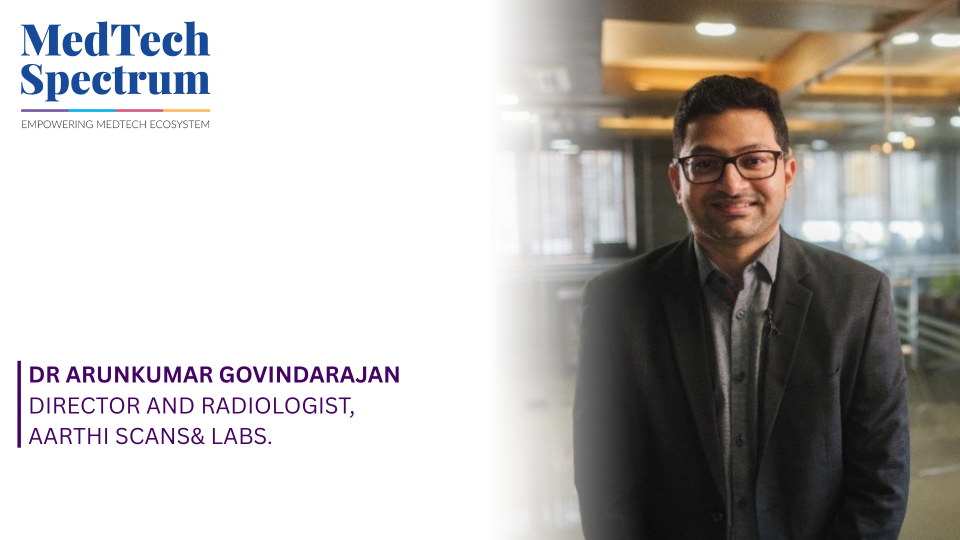
In this interview with MedTech Spectrum, Dr Arunkumar Govindarajan, Director and Radiologist at Aarthi Scans & Labs, discusses the nationwide adoption of BoneXpert across the organisation’s 100-centre network. He explains how AI-driven bone age analysis is eliminating inter- and intra-observer variability, improving diagnostic confidence, and enabling more reliable longitudinal monitoring for paediatric patients. Dr Govindarajan also shares insights into workflow integration, change management at scale, and how platforms like BoneXpert are helping shift diagnostic imaging in India toward predictive, precision-driven healthcare.
Bone age assessment has traditionally been subjective and observer-dependent. How does BoneXpert change clinical decision-making for paediatricians and endocrinologists compared to conventional manual methods?
Bone age assessment has historically relied on visual comparison of hand X-rays against reference atlases, making the process inherently subjective and dependent on the experience and interpretation of the reporting physician. Even among skilled radiologists, this can lead to inter-observer and intra-observer variability, particularly in borderline cases or when monitoring subtle changes over time. BoneXpert fundamentally changes this dynamic by converting bone age assessment into a standardised, algorithm-driven measurement.
Instead of relying on visual judgment, BoneXpert analyses the X-ray using validated algorithms and produces a reproducible bone age result every time. This consistency removes ambiguity from the assessment process and allows paediatricians, orthopaedicians, and endocrinologists to base their clinical decisions on objective data rather than interpretive opinion. As a result, clinicians can have greater confidence when diagnosing growth delays, precocious puberty, or endocrine disorders, and when deciding on interventions such as hormone therapy or treatment adjustments.
Equally important is the role BoneXpert plays in longitudinal follow-up. Because results are reproducible, clinicians can reliably compare bone age measurements across different time points, even if the imaging was done at different centres or reported by different physicians. This supports clearer trend analysis, improves treatment monitoring, and enables more informed, data-driven clinical conversations with patients and families.
What factors led Aarthi Scans & Labs to adopt BoneXpert across its entire 100-centre network, and why was this the right time for a pan-India AI rollout?
The decision to implement BoneXpert across Aarthi Scans & Labs’ entire 100-centre network was driven by a convergence of clinical demand, service expectations, and technological readiness. Clinicians increasingly seek objective, evidence-based diagnostic tools that reduce variability and support confident decision-making, particularly in paediatric growth and endocrine assessments where precision is critical. At the same time, referrals for paediatric endocrine evaluations have been steadily rising, creating a need for consistent and scalable bone age assessment across geographies.
From an operational perspective, the organisation’s Picture Archiving and Communication System (PACS) infrastructure was already prepared to support the deployment of clinically validated AI solutions at scale. This readiness made it possible to roll out BoneXpert in a structured, controlled manner without compromising workflow efficiency or report quality. Rather than implementing AI in isolated centres, a pan-India deployment ensured uniform standards of care across the network.
The timing was therefore appropriate because clinical expectations, referral patterns, and internal systems were aligned. Implementing BoneXpert at this stage allowed Aarthi Scans & Labs to respond proactively to clinician needs while strengthening consistency across its diagnostic services. By adopting a solution that integrates seamlessly into existing workflows, we ensured that AI adoption enhanced clinical value rather than adding complexity.
One of BoneXpert’s key strengths is eliminating inter- and intra-observer variability. How important is standardisation in large diagnostic networks, and what impact does it have on long-term patient monitoring and outcomes?
In large diagnostic networks, standardisation is not just a quality goal but a clinical necessity. When multiple centres, radiologists, and clinicians are involved, even small variations in reporting can lead to differences in diagnosis, treatment decisions, and follow-up strategies. In bone age assessment, such variability can directly influence how a child’s growth pattern is interpreted and managed over time.
BoneXpert addresses this challenge by ensuring that the same X-ray produces the same result regardless of where it is performed within the network. This uniformity eliminates discrepancies caused by individual interpretation and establishes a consistent diagnostic baseline across all centres. For clinicians, this means they can trust that a bone age result from one location is directly comparable to a previous or future study from another location.
The impact on long-term patient monitoring is significant. Reliable, standardised measurements allow for accurate longitudinal comparisons, helping clinicians track growth trends, assess treatment response, and make timely adjustments. This reduces the risk of misclassification or delayed intervention. For patients and families, it translates into clearer explanations, fewer conflicting opinions, and more confidence in care decisions. Ultimately, standardisation supports safer, more predictable, and more outcome-focused care across large diagnostic networks.
How was BoneXpert integrated into existing radiology workflows, and what were the key operational or change-management challenges during nationwide implementation?
BoneXpert was integrated into existing radiology workflows in a way that required no change to image acquisition protocols or reporting practices. The system works entirely in the background, ensuring that radiologists and clinicians experience no additional steps or workflow burden. The PACS software automatically recognises the Digital Imaging and Communications in Medicine (DICOM) study description, anonymises the study, sends it to the BoneXpert server hosted within the organisation’s premises, and retrieves the results as DICOM PDF and DICOM Structured Report formats. These are then seamlessly returned to the PACS for review.
Because the entire process is automated, there is no manual intervention required at any stage, which significantly reduces operational complexity. This design choice was critical in ensuring smooth adoption across a large, geographically distributed network. Radiologists could access BoneXpert results within their familiar PACS environment, eliminating the need for separate logins or parallel systems.
From a change-management perspective, adoption was smooth largely because the technology did not disrupt established workflows. Since BoneXpert complemented existing processes rather than replacing them, resistance to change was minimal. Training requirements were also limited, as users interacted with the results rather than the underlying system. Overall, the focus on seamless integration ensured that nationwide implementation could be achieved efficiently and consistently.
Has the use of AI-driven bone age analysis improved reporting speed, diagnostic confidence, or treatment planning for clinicians? Are you already seeing measurable benefits in patient care?
Yes, early feedback indicates that AI-driven bone age analysis has positively influenced both diagnostic confidence and treatment planning. Clinicians report clearer assessment of child growth trends, which supports more decisive clinical decision-making. By providing consistent, objective bone age measurements, BoneXpert helps reduce uncertainty, particularly in cases where visual assessment might otherwise be ambiguous.
A key advantage is the availability of bone age results using three different methods, each serving a specific clinical purpose. GP bone age is the primary and most commonly used measure in routine practice, offering a reliable baseline assessment. Carpal bone age acts as a supportive measure, especially in younger children or borderline cases, as carpal bones mature later and can uncover skeletal immaturity that may not be evident in GP bone age alone. This is particularly helpful in distinguishing constitutional growth delay or endocrine suppression.
TW (Tanner–Whitehouse) bone age is valuable in more complex or specialist cases, such as during puberty or in endocrine disorders, where individual bone scoring can reveal asynchronous skeletal maturation. Having all three measures available in a single, automated assessment allows clinicians to choose the most appropriate metric for each case, enhancing diagnostic clarity and supporting tailored treatment planning.
Looking ahead, how do you see AI reshaping diagnostic imaging in India, and what role do platforms like BoneXpert play in moving diagnostics toward more predictive, precision-driven healthcare?
AI is set to move diagnostic imaging in India from primarily descriptive reporting toward predictive and precision-driven healthcare. Instead of imaging being limited to visual interpretation alone, AI will enable the extraction of quantitative imaging biomarkers that directly inform prevention, diagnosis, and treatment strategies. These measurable parameters can be tracked over time, much like laboratory values, supporting proactive and personalised care.
With AI, clinicians will be able to access imaging biomarkers such as liver fat percentage, liver iron concentration, visceral fat mass, abdominal organ volumes, and coronary calcium scores. These quantitative metrics offer deeper insight into disease risk, progression, and treatment response, enabling earlier intervention and more personalised care. Because these values can be measured consistently, they support longitudinal monitoring in the same way blood markers do today.
Platforms like BoneXpert represent this transition by demonstrating how imaging data can be converted into standardised, reproducible numerical outputs rather than subjective interpretations. As more AI tools are integrated into routine practice, imaging will become an active component of predictive healthcare rather than a standalone diagnostic snapshot. This evolution will strengthen clinical decision-making, improve monitoring accuracy, and position diagnostic imaging as a key driver of precision medicine in India.