India’s healthcare sector is undergoing a significant structural transformation. Traditionally dominated by doctor-led enterprises and family-run charitable trusts, it is now increasingly being shaped into a financialised asset class, attracting sustained interest from global private equity (PE) firms like Blackstone, KKR, and Temasek. While this influx of capital is accelerating modernisation and scaling efforts, it also raises critical ethical, economic, and policy concerns about the future of patient care in the country.
Profit Timelines vs. Patient Outcomes
According to Vinoth MJ Mohan, Founder of MEDJOBS.APP, a fundamental tension exists at the heart of this transition, characterised by two contrasting operating models. Private equity firms typically pursue investment horizons of five to seven years, aiming for high internal rates of return before exiting through public listings or secondary sales. In contrast, healthcare delivery is a long-term sector where clinical excellence, trust, and outcomes often take decades to develop.
This mismatch in timelines poses inherent risks. When hospitals face pressure to meet aggressive EBITDA targets, there is a growing incentive to prioritise high-margin procedures—such as elective orthopaedics or advanced interventions—over essential but lower-margin services like primary care, preventive health, and long-term patient management. Although hospital management often emphasises clinical autonomy, financial pressures can subtly influence decision-making regarding service offerings and resource allocation.
Consolidation and the Rise of Hospital Oligopolies
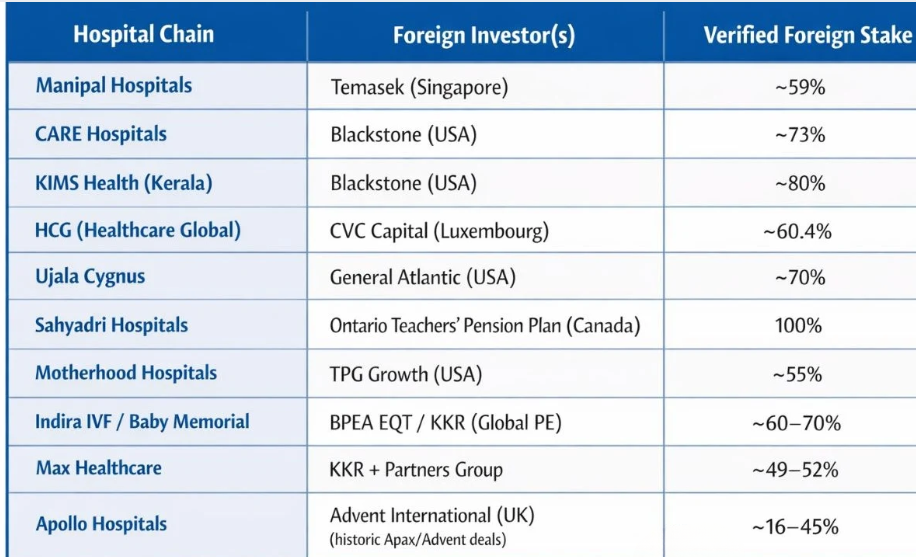
Another prominent feature of the private equity influx is rapid consolidation. Large hospital networks backed by private equity are acquiring smaller regional players, resulting in extensive chains with significant pricing power. Examples include Manipal Health Enterprises (backed by Temasek) and KIMS-Ushalakshmi (backed by Blackstone).
In major urban markets, this consolidation risks creating oligopolistic conditions where a handful of hospital chains dictate the effective price floor for medical procedures. Reduced competition could ultimately increase costs for India’s middle class, which already faces one of the highest out-of-pocket healthcare expenditure burdens globally.
Patient Data and Sovereignty Concerns
Foreign ownership also raises critical questions surrounding data sovereignty. With some hospital groups now having 80–100 per cent foreign ownership, the control of vast amounts of Indian patient health data becomes both a strategic and regulatory concern.
These datasets are increasingly valuable for artificial intelligence development, pharmaceutical research, and insurance analytics. Ensuring that this sensitive information remains compliant with India’s Digital Personal Data Protection (DPDP) Act, 2023, becomes more complex when parent companies are based overseas, highlighting the need for clearer cross-border health data governance frameworks.
The Upside: Infrastructure, Technology, and Standardisation
Despite these challenges, the positive impact of private equity investment cannot be overlooked. The infusion of foreign capital has facilitated significant upgrades in healthcare infrastructure, including advanced diagnostic platforms, robotic surgery systems, and high-end critical care facilities—investments often beyond the reach of standalone Indian promoters.
Moreover, large institutional ownership has driven greater standardisation in clinical protocols, billing transparency, and operational processes, improving efficiency and consistency across hospital networks.
A Sector at a Crossroads
India's healthcare system now finds itself at a critical juncture. The challenge for policymakers, regulators, and healthcare leaders is to leverage the benefits of scale, capital, and professional management brought by private equity while preserving clinical independence, affordability, and patient-centric care.
As global capital continues to flow into the sector, the choices India makes will determine whether healthcare evolves as a sustainable public good or becomes overly influenced by short-term financial imperatives.