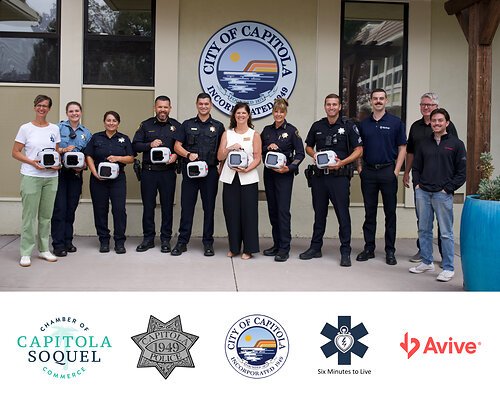
The Capitola Police Department in California has equipped every patrol vehicle in its fleet with an automated external defibrillator (AED), following a donation coordinated by Six Minutes to Live: Santa Cruz.
The initiative was made possible through contributions from Avive, an AED manufacturer based in the San Francisco Bay Area, and the Capitola-Soquel Chamber of Commerce. Avive donated half of the AEDs, while the remaining devices were funded by the Chamber of Commerce.
With AEDs now available in every patrol vehicle, Capitola police officers will be able to provide defibrillation alongside CPR when responding to cases of sudden cardiac arrest (SCA), potentially providing critical intervention before fire and emergency medical services arrive.
“Every second matters during a cardiac emergency. By equipping every Capitola Police patrol vehicle with an AED, our officers are better prepared to provide immediate, lifesaving care while waiting for fire and EMS personnel to arrive,” said Sarah Ryan, Chief of Police, Capitola Police Department.
Sudden cardiac arrest can occur without warning, and the likelihood of survival decreases with every minute that defibrillation is delayed. Immediate CPR combined with early AED use can significantly improve the chances of survival.
The donation was coordinated by Six Minutes to Live: Santa Cruz, a local organisation focused on improving cardiac arrest survival through public access to defibrillation.
“The science is clear: patients who receive interventions in the first minutes of collapse have much better outcomes,” said Hilary Gates, Santa Cruz resident and co-founder of Six Minutes to Live.
The initiative highlights the growing role of AEDs in expanding access to emergency cardiac care beyond hospitals and ambulances. Equipping first responders with portable defibrillators can enable earlier intervention during the critical initial minutes of a cardiac emergency.