Dr. Christopher Good
VSI® Spine Surgeon Dr. Christopher Good has achieved a historic milestone in robotic spine surgery, performing the world's first minimally invasive robotic Bertolotti's resection surgery at Reston Hospital Center (HCA Virginia Health System). This first-ever procedure introduces a transformative surgical option for patients suffering from chronic low back pain caused by Bertolotti syndrome, an underdiagnosed spinal condition affecting an estimated 4-8% of the population.
Traditionally, resection surgery for Bertolotti syndrome can require large incisions and significant tissue disruption to access the deeply positioned transitional bone. Dr. Good's innovative approach replaces this extensive exposure with a precisely planned, robot-guided procedure that dramatically reduces surgical impact.
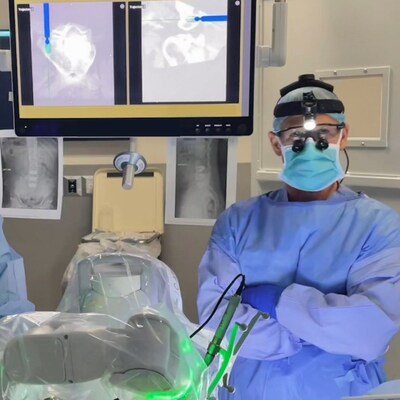
Using sophisticated preoperative computerized planning, Dr. Good mapped the exact angles and trajectories for each bone cut before entering the operating room. This plan allowed for robotic-assisted execution through a single 22-millimeter minimally invasive incision, enabling targeted removal of the pain-generating bone while preserving surrounding muscle and soft tissue.
"As the world's leading destination for Bertolotti surgery and robotic spine surgery, VSI has a responsibility to push the field forward," said Dr. Good. "This advancement reflects our commitment to giving patients modern options, safer care, and a smoother recovery."
This achievement marks a major step forward in the evolution of robotic spine surgery. While robotic systems have historically been used primarily for implant placement, this case demonstrates their expanding ability to support high-precision bone removal. Dr. Good previously served as lead author on the first scientific publication validating robotic bone-cutting in minimally invasive spine surgery, foundational work that helped enable this advancement.
Because of the smaller incision and reduced tissue disruption, patients benefit from:
"Performing this surgery robotically reflects what's possible when innovation is driven by the needs of our patients," Dr. Good said. "As technology continues to evolve, we're able to support even the most unique spinal conditions with greater precision, less disruption, and a more hopeful healing experience."