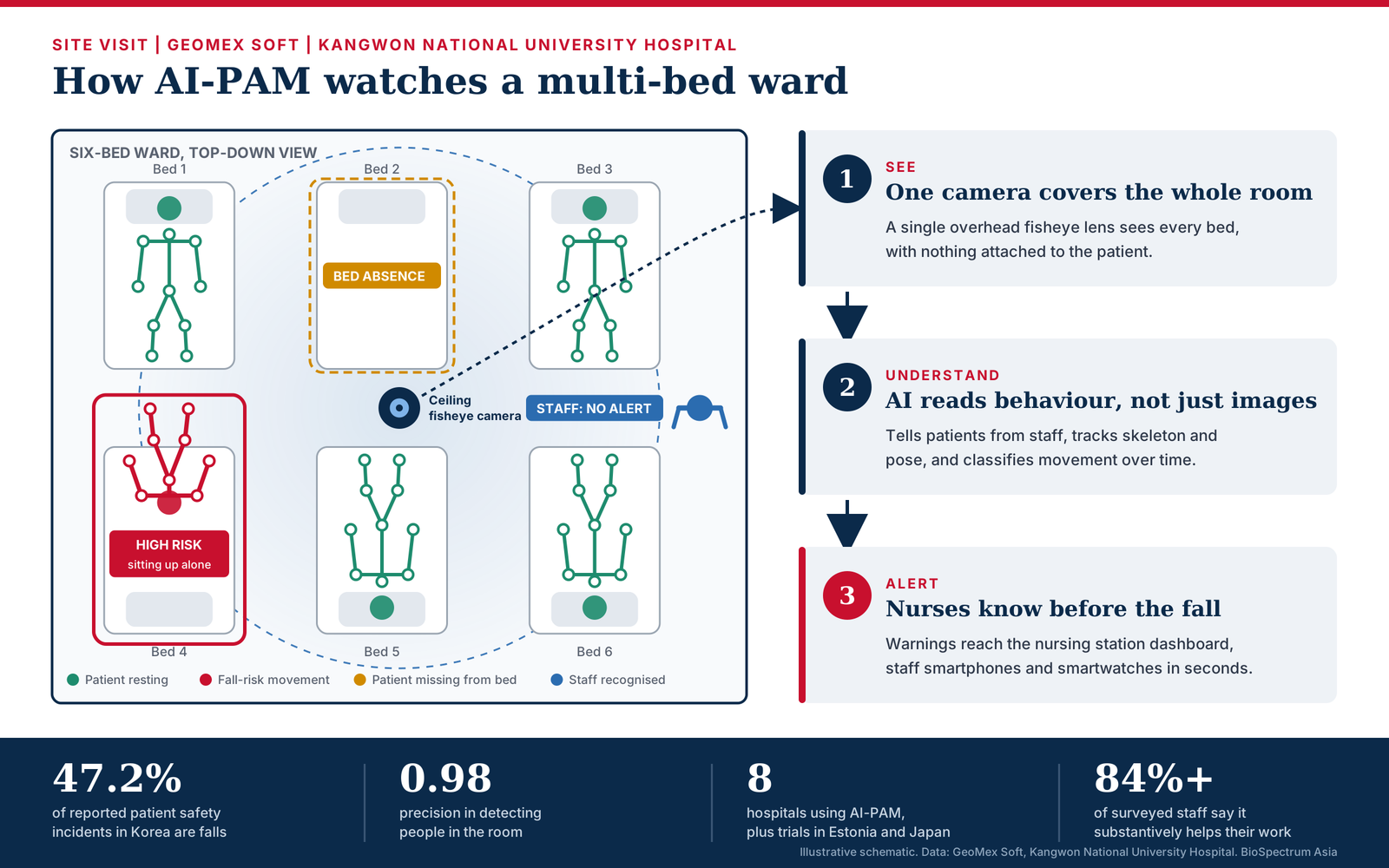
Picture a six-bed ward at two in the morning. One nurse is at the far end changing a drip. In bed four, an elderly patient recovering from surgery decides she can manage the bathroom on her own. She sits up, swings her legs towards the rail and starts to stand. In a conventional ward, the first anyone hears of it is the sound of the fall.
In the wards of Kangwon National University Hospital in Chuncheon, a fisheye camera on the ceiling sees her sit up. Software recognises the posture as a fall-risk movement, separates her from the nurse across the room, and sends an alert to the nursing station and to the nurse's smartwatch before her feet touch the floor. That, in a sentence, is AI-PAM, the AI-based patient care monitoring system built by Gangwon software company GeoMex Soft, and the subject of a demonstration for international delegates attending the 2nd Global Innovation Special Zone Forum this week.
The accident hospitals cannot afford
Falls rarely make headlines, yet they are the single biggest patient safety problem in Korean hospitals. Of the 13,146 patient safety incidents reported nationally in 2021, 6,199, or 47.2 per cent, were falls. Nearly four in five involved patients aged 60 or older. At Kangwon National University Hospital, the only national university hospital in Gangwon Province, 45.4 per cent of inpatients that year were 65 or older.
The arithmetic is getting worse. Korea is ageing faster than almost any other developed economy, and more patients are being cared for in integrated nursing and care service wards, where nurses rather than family members or private carers watch over patients. One nurse cannot be beside every bed at once, and a fall in an older patient can mean a fracture, a longer stay and, sometimes, a life that never returns to independence.
Most fall technology tells you a patient is on the floor. AI-PAM is designed to tell you a patient is about to be.
From city CCTV to the hospital ward
GeoMex Soft is an unlikely healthcare innovator, which is part of what makes the story interesting. Four developers founded it in 2009 at a start-up centre in Chuncheon. Its core business is geospatial and CCTV control software, now used by around 170 local governments across Korea for public safety monitoring. By 2024 it had 89 employees and reported annual sales of KRW 14.9 billion.
The jump into healthcare came in 2021, when Kangwon National University Hospital and GeoMex Soft were selected for a national smart hospital leading model project in the patient safety category. The hospital brought the clinical problem and the wards. The company brought a decade of experience teaching cameras to understand what people are doing in a scene. Together they built AI-PAM and deployed it in the hospital's integrated nursing and care service wards.
The system was later upgraded through an AI medical solution demonstration programme run by the Gangwon Information and Culture Industry Promotion Agency with support from the Ministry of Science and ICT and NIPA. In December 2025, the hospital and the company signed a fresh agreement to refine the system for different ward types, run joint clinical research and take it further into commercial use.
|
Solution |
AI-PAM (AI-based Patient cAre Monitoring system) |
|
Developer |
GeoMex Soft, Chuncheon, Gangwon. Founded 2009; CCTV control software supplier to some 170 local governments |
|
Clinical partner |
Kangwon National University Hospital, co-developer since the 2021 smart hospital leading model project |
|
What it detects |
Falls, fall-risk behaviour, bed exits, absence from bed and pressure ulcer risk in multi-bed wards |
|
How it alerts |
Nursing station dashboard with live room view, plus smartphone and smartwatch notifications |
|
Recognition |
2026 KHF Innovation Award; exhibited at Arab Health 2025 |
How a camera learns to see a fall coming
The technical design is built around the realities of a Korean multi-bed room. A single fisheye camera mounted on the ceiling covers the whole room from above. GeoMex Soft adapted Google's Panoptic DeepLab segmentation architecture to work on these top-down, distorted images, so the system can recognise the room layout, the beds and the people in it, and tell patients apart from staff.
On top of that sits behaviour recognition. Skeleton and pose estimation track how each patient's body is positioned, and action recognition models analyse movement over time. The result is a running classification of what each patient is doing: lying still, sitting up, leaning over a rail, leaving the bed, or already down. The same visual stream also tracks prolonged immobility, which matters for pressure ulcers, and whether a patient is missing from the bed.
Alerts arrive in three places. A dashboard at the nursing station shows the status of every bed, with fall and pressure ulcer warnings, bed absences and a live room view. The same alerts reach staff smartphones and smartwatches, so a nurse busy in another room still knows within seconds. Because the system is web-based, it runs on the PCs and tablets a ward already has.
GeoMex Soft reports precision of 0.98 and recall of 0.90 for detecting people in the room, and average accuracy of 0.90 for recognising posture.
Prevention, not just detection
Two design choices separate AI-PAM from much of the fall technology on the market. The first is timing. Many products, from pressure mats to wearable pendants, are good at confirming that a fall has happened. AI-PAM is built to flag the behaviour that comes before a fall, such as sitting up unassisted or climbing towards a rail, so a nurse can intervene in time.
The second is risk reclassification. Hospitals assess fall and pressure ulcer risk at admission using standard scoring tools, and those scores shape how closely a patient is watched. But a patient scored as low risk on paper may behave very differently at night. AI-PAM can move such a patient into a potential high-risk group based on what the camera actually observes, and the behavioural record it builds over a stay can inform further reassessment. In effect, it turns a one-time checklist into a continuous assessment.
Staff appear to welcome it. An earlier survey found about 80 per cent of medical staff using AI-PAM said it gave them practical help, and a more recent survey put that figure above 84 per cent. A hospital official has said patient safety incident prevention and nursing efficiency have improved significantly since adoption.
|
AI-PAM AT A GLANCE |
|
|
47.2% |
Share of Korea's 13,146 reported patient safety incidents in 2021 that were falls, the largest single category |
|
78.9% |
Share of those falls involving patients aged 60 or older |
|
0.98 / 0.90 |
Precision and recall of AI-PAM's person detection, with posture recognition averaging 0.90 accuracy, per GeoMex Soft |
|
84%+ |
Medical staff in a recent survey who said AI-PAM substantively helped their work |
|
8 |
Hospitals running AI-PAM, including Kangwon National University Hospital and the Armed Forces Capital Hospital |
|
2 |
Overseas demonstration countries: Estonia (Tartu University Hospital) and Japan |
Sources: GeoMex Soft, Kangwon National University Hospital, site visit briefing materials and Korean media reports.
From one hospital to eight, and beyond Korea
AI-PAM is now deployed in eight hospitals, including Kangwon National University Hospital, Sokcho Medical Center and the Armed Forces Capital Hospital, the flagship of Korea's military medical system. That last site is a useful endorsement: military hospitals care for a very different patient population, which suggests the system's value is not limited to elderly wards.
The company is also testing the system abroad. Overseas demonstrations have been running for around two years at Tartu University Hospital in Estonia, one of Europe's most digitally advanced health systems, and at a hospital in Japan, the world's most aged society. GeoMex Soft exhibited at Arab Health in Dubai in 2025, and in August 2026 it received a KHF Innovation Award at the Korea Healthcare Festival in Seoul, which recognises companies expected to lead Korea's future medical industry.
Gangwon as a test bed
AI-PAM's growth is closely tied to Gangwon Province's bid to become Korea's AI healthcare test bed. The company operates within the province's AI Healthcare Global Innovation Special Zone, a regulation-free zone where companies can run demonstration projects that existing rules might otherwise slow down. The forum taking place this week showcases the zone's achievements to overseas partner institutions.
The ambition is growing. In August 2026, the Ministry of Science and ICT launched planning for a Gangwon healthcare and wellness AI transformation project, with a pilot due in 2027 and full rollout in 2028. Gangwon already hosts the headquarters of the National Health Insurance Service and the Health Insurance Review and Assessment Service, and Wonju is one of Korea's main medical device clusters. For a company like GeoMex Soft, that combination of payers, regulators, hospitals and manufacturers in one province is a real advantage.
Where AI-PAM fits in Korea's monitoring wave
Korean hospitals are adopting AI patient monitoring from several directions at once. Wearable-led platforms such as Seers Technology's thynC, distributed by Daewoong Pharmaceutical, stream ECG, oxygen saturation and other vital signs from sensors on the patient's body. Prediction software such as VUNO's DeepCARS reads routine vital signs to estimate cardiac arrest risk. AI-PAM takes a third route, reading behaviour through vision.
These approaches are complementary rather than competing. Wearables see inside the body but depend on patients keeping a device on, which confused or restless patients often do not. A ceiling camera needs nothing attached to the patient and sees what wearables miss: the moment someone decides to get out of bed. A fully smart ward will likely need both kinds of signal, brought together in one view.
The questions still to answer
Why this is the first step
It would be easy to dismiss AI-PAM as a narrow tool for a single problem. That would miss the point. A smart hospital is not a building full of robots. It is a hospital that knows, in real time, what is happening to every patient, and responds before harm occurs. For most general wards in the world, that awareness still depends on a nurse walking past at the right moment.
AI-PAM replaces that luck with continuous attention, starting with the accident that hurts the most patients. The visual data it generates, about how patients move, rest and recover, is also the raw material for the next generation of ward intelligence. For hospital leaders across Asia-Pacific, including India, where ward nursing ratios are stretched and populations are ageing, the Gangwon model offers a practical lesson. The smart hospital starts with a single, well-chosen problem, solved well, in a real ward.
Note: Performance figures, survey results and deployment numbers are as reported by GeoMex Soft, Kangwon National University Hospital and site visit briefing materials, and have not been independently audited. Information current as of 28 October 2026.