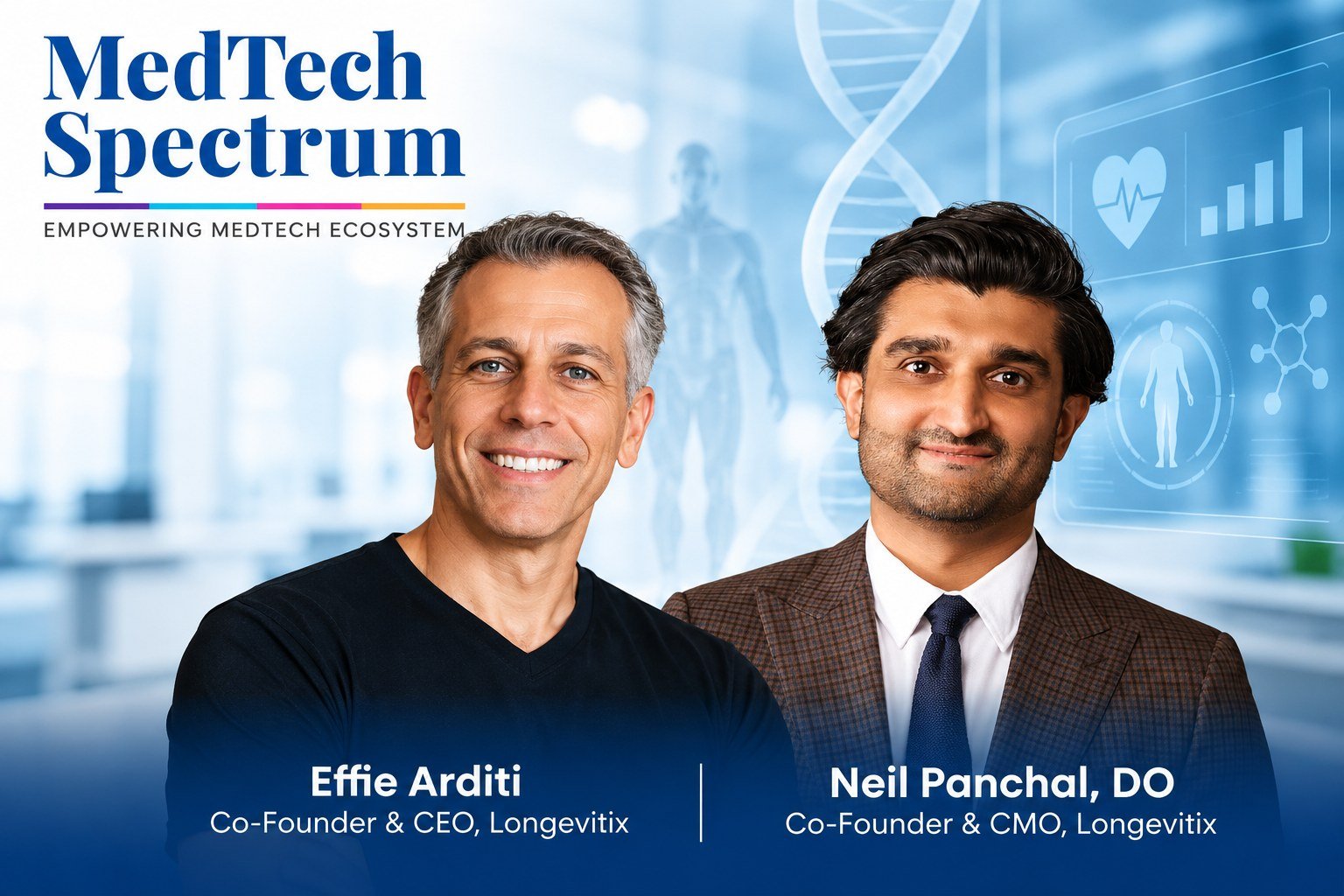
As longevity medicine gains momentum globally, the challenge is shifting from extending lifespan to delivering measurable improvements in healthspan. While biological-age clocks, advanced diagnostics and emerging therapies are attracting growing interest, questions remain over clinical validation, regulatory frameworks and their practical application in mainstream healthcare. In an exclusive interview with MedTech Spectrum, Effie Arditi, Co-Founder and CEO, and Dr Neil Panchal, Co-Founder and Chief Medical Officer of Longevitix, explore the widening gap between consumer expectations and clinical evidence, the role of AI in connecting patient data with physician-led decisions, and the innovations needed to transform longevity medicine into a credible, evidence-based model of preventive healthcare.**
Where is the biggest gap today between what longevity science can demonstrate and what consumers are being led to expect?**
**Effie Arditi:** The widest gap we see sits between what patients now expect and what physicians are equipped to deliver. Patients arrive better informed. They have access to advanced lab testing, sophisticated wearables, and new treatments, and they often see their own data before their physician does. Their expectations have risen accordingly. They want deeper insight into their own biology, guidance built around their history and habits, and care that continues between appointments.
Physicians are being asked to meet those expectations, usually without the tools or the time to do it. They are expected to make sense of specialty labs, continuous wearable streams, lifestyle habits, and medical history, and to stay connected with patients between visits. Each of those sources arrives in a different format, on a different schedule, and often in a different system. The work of[ assembling them into one unified picture of the patient](https://longevitix.co/blog/why-preventive-medicine-fails-without-data-unification) falls on the physician, before any clinical thinking can start.
When a patient brings a stack of results to a 30-minute appointment, the question they are asking is whether anyone can interpret all of it in the context of their own health. That creates a growing need for AI systems that bring these data together, interpret them in the context of each patient's health and behavior, and help physicians deliver the depth and continuity of care their patients expect, with the physician making every clinical decision.
Different epigenetic clocks can produce different results for the same person. What would it take to establish a clinically meaningful, internationally accepted standard for biological age?**
**Neil Panchal, DO:** I need three things from any test before I use it with a patient: it reproduces, it predicts outcomes, and it moves in response to an intervention in a way that tracks a change in those outcomes. Epigenetic clocks are strongest on the second and weakest on the first and third. A 2022 Nature Aging study found that technical noise alone produced[ deviations of up to nine years between replicate measurements of the same sample](https://www.nature.com/articles/s43587-022-00248-2) across six prominent clocks. The same group showed that a principal-component method brought most replicates within 1.5 years, so the problem is solvable.[ Different clocks also measure different dimensions of aging](https://longevitix.co/blog/biological-age-clocks-explained), so some disagreement between them is expected; noise within a single clock is the harder problem. Until reproducibility is routine, I can't use a two-year change to monitor a patient, and monitoring is the main reason I would order the test.
A real standard would look like every other laboratory standard: shared reference materials, inter-laboratory proficiency testing, and reporting rules that require each result to state which clock, which platform, and what confidence interval. The groundwork exists. The Biomarkers of Aging Consortium published[ a validation framework in Nature Medicine](https://www.nature.com/articles/s41591-023-02784-9) calling for benchmarking, open data, and open-source clock formulas. The field still lacks agreement on which outcomes a clock has to predict before it earns a place in clinical decisions. I would like the field to converge on a small number of measures anchored to hard endpoints (cardiovascular events, dementia, disability, death), and to require that every result reaching a patient carries its method and error range.
If a test says someone is aging faster or slower than their chronological age, how actionable is that today? What interventions have sufficient evidence behind them?**
**Neil Panchal, DO:** On its own, a biological-age result is a prompt to look harder. What I can offer with real evidence is a familiar list, and none of it needs a clock to justify it. Cardiorespiratory fitness is the strongest single intervention I know: in more than 122,000 adults who underwent treadmill testing,[ elite fitness was associated with an 80 percent lower risk of death](https://jamanetwork.com/journals/jamanetworkopen/fullarticle/2707428) compared with the lowest fitness group, with no upper limit of benefit observed. The rest of the list is resistance training for muscle and bone, treating blood pressure, ApoB, and glucose to target, protecting sleep, and stopping smoking. For patients with obesity and established cardiovascular disease, semaglutide has outcome data:[ a 20 percent reduction in major cardiovascular events in the SELECT trial](https://newsroom.clevelandclinic.org/2023/11/11/international-clinical-trial-finds-that-semaglutide-reduced-cardiovascular-events-by-20-in-adults-with-overweight-or-obesity-who-dont-have-diabetes).
A clock becomes more useful as one line in a longitudinal record. If a patient's biological age moves alongside their fitness, glucose, and inflammatory markers, I take it seriously. If it moves alone, I suspect measurement noise. A "fast" result can also be a useful motivator for a patient who has ignored the basics for years. I would still take a patient's VO₂ max, ApoB, and HbA1c trend over any single biological-age value.
Senolytics, partial epigenetic reprogramming, and GLP-1 agents are attracting attention. Which developments are most likely to move longevity medicine toward evidence-based preventive care?**
**Neil Panchal, DO:** GLP-1 receptor agonists, by a wide margin, because they already have hard outcomes: cardiovascular benefit in SELECT,[ kidney outcome data from the same trial](https://www.ncbi.nlm.nih.gov/pmc/articles/PMC11271413/), and a growing list of conditions they appear to touch. They are the first drug class where treating one condition and shifting several age-related risks at once start to look like the same thing.
Senolytics are promising in animals and inconsistent in people so far;[ a small pilot of dasatinib plus quercetin in Alzheimer's disease](https://lifespan.io/results-of-a-phase-1-trial-of-senolytics-for-alzheimers/) found very few significant biomarker changes. Partial reprogramming entered human testing this June, when Life Biosciences[ dosed the first patient with ER-100](https://www.lifebiosciences.com/life-biosciences-announces-first-patient-dosed-in-phase-1-trial-of-er-100-for-optic-neuropathies/), a Phase 1 safety trial in optic neuropathies that plans to enroll up to 18 people and treats one eye each. That is years of work away from anything I would offer a healthy 50-year-old.
The development that would move the whole field is a validated surrogate endpoint. If a biomarker of aging is accepted as predicting hard outcomes, a prevention trial shrinks from decades to a few years, and far more candidate interventions can be tested.
Ageing is not recognised as a disease indication by major regulators. How does this affect trial design and the ability to show that an intervention extends healthspan?**
**Effie Arditi:** It shapes where the money goes before any trial is designed. A drug has to be developed for a specific disease, so a compound with broad, modest effects across many conditions has no natural sponsor, especially if it's off-patent. The clearest example is TAME, the trial of metformin designed around a composite of cardiovascular disease, cancer, dementia, and death. It was conceived as a template for studying aging as the target, and[ its funding has depended largely on philanthropy](https://www.afar.org/tame-trial) because a generic drug offers little commercial return. More than a decade after it was proposed, it still has no efficacy results. In practice, the regulatory frame decides which research gets funded.
**Neil Panchal, DO: **The single-disease frame also misses how patients age. When we talk with longevity physicians, they describe diagnoses arriving in clusters: hypertension, then prediabetes, then a knee that limits walking, then a fall. The intervention that matters most is one that delays the second and third diagnosis, and trials rarely measure that. Healthspan is measurable today with functional outcomes: time to a second chronic disease, gait speed, grip strength, and the WHO's concept of intrinsic capacity. Those endpoints capture whether a person is living well for longer, and they are closer to what patients care about.
Looking ahead five to ten years, what needs to happen across regulation, clinical evidence, diagnostics, and physician education for longevity medicine to become part of mainstream healthcare?**
**Effie Arditi:** We would point to specific milestones on each front. Regulation needs[ reporting standards](https://longevitix.co/blog/longevity-medicine-is-growing-up) for biological-age tests that require method, platform, and error range on every result. Clinical evidence needs at least one accepted surrogate endpoint, plus pragmatic trials and registries that pool outcomes across clinics. Diagnostics need cross-laboratory calibration, so a result from one provider means the same thing from another. Physician education needs to cover competencies most clinicians were never trained in: exercise prescription with the precision of a drug prescription, interpretation of multi-omic and wearable data, and explaining uncertainty to a patient who wants a definite answer.
All four depend on[ infrastructure for continuous care](https://longevitix.co/blog/care-stopped-being-an-event-digital-twins-and-the-shift-to-continuous-longevity-care). Patients need an AI agent that knows them, with access to their full medical records, family history, and life history alongside their WHOOP or Oura data. That agent has to connect them to their physician and bring the physician up to speed with all of that context. We think of it as a triangle of patient, agent, and physician. The agent holds the context and keeps it current between visits. The physician reviews what the agent surfaces and makes every clinical decision. The patient stays connected to both.
Every mainstream specialty went through a period in which practice ran ahead of standards, and cardiology and oncology both moved past it by documenting outcomes until the evidence was strong enough to change guidelines. Longevity medicine is entering that stage now. Consumer demand built the category, and its credibility will come from physicians who can show, patient by patient and year by year, what changed and why.