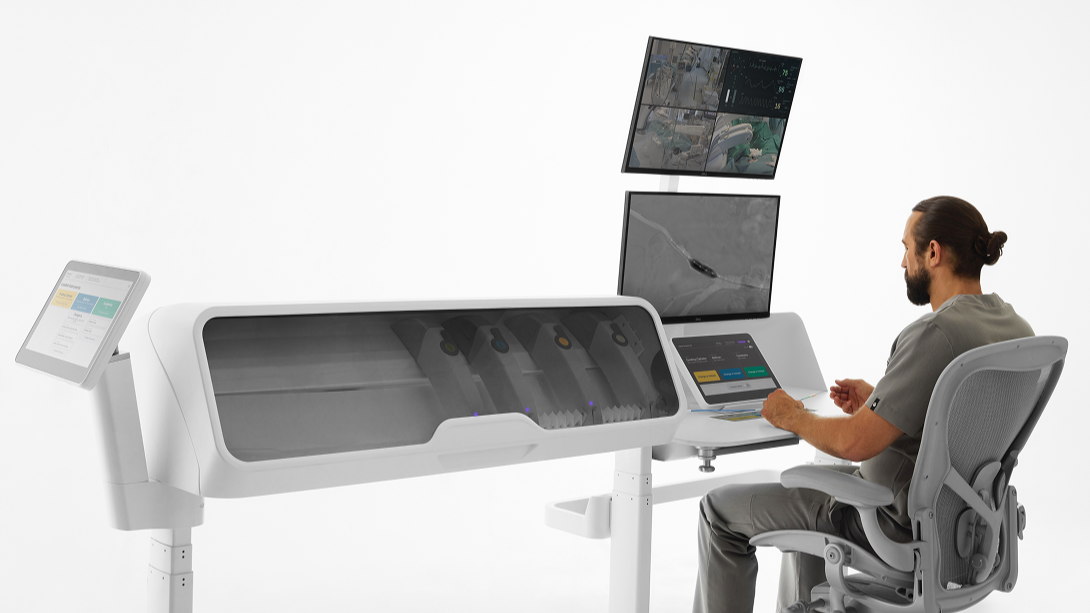
Sentante, the medical robotics company building a haptic, device-agnostic platform for remote vascular surgery, today unveiled how it is taking its physical AI strategy to market - with commercial deployment of its CE-marked endovascular robotic platform beginning in vascular surgery and interventional radiology.
The choice of first market determines both where the platform proves itself in daily clinical use and where the data foundation for endovascular physical AI begins to build at clinical scale. The company has already detailed why drive-side force and torque sensing is the substrate endovascular physical AI requires as clinical guidelines drive imaging down, and why its 1:1 motion-mimicking interface is what makes every captured procedure a training-grade record of expert clinical skill rather than a filtered approximation of it.
The platform was designed for catheter-and-guidewire intervention through compliant vascular anatomy, and that is the procedural physics of vascular surgery and interventional radiology in its broadest expression: peripheral arterial intervention, embolisation, interventional oncology.
Force and torque sensing at the catheter drive, the 1:1 motion-mimicking interface that lets existing interventionalists operate from day one without retraining, and device-agnostic actuation across the standard catheter and guidewire portfolios these specialties already use all converge on the daily practice of the vascular surgeon and the interventional radiologist. The system integrates with existing cath-lab infrastructure, so deployment fits the clinical environment as it stands.
"Vascular surgery and interventional radiology are the specialties Sentante was built to serve first," said Edvardas Satkauskas, CEO and co-founder of Sentante. "The platform earns its place on daily clinical volume, supports the interventionalists who treat these patients every day, and the data substrate that endovascular physical AI requires accumulates in real clinical use only."
The multi-modal data the platform records- drive-side force and torque, device kinematics and time-aligned fluoroscopy captured together on every procedure- begins to accumulate at clinical scale from the first commercial case in these specialties. Because the mechanical signatures of safe versus unsafe catheter-vessel contact are continuous across vascular indications, the data the platform records here is the data that trains every subsequent capability on the AI roadmap.
The substrate also compounds. Every procedure performed on the platform contributes to a richer expert dataset; a richer dataset produces better AI; better AI produces a more capable platform; and a more capable platform sustains more procedures. The loop is embedded in the clinical workflow itself: no synthetic data, no retrospective re-labelling, no separate data-acquisition campaign. Real-world procedural data, captured under the conditions of routine clinical practice, is what builds the asset on which endovascular physical AI is trained.
"These are the specialties where my colleagues treat the highest volume of patients with catheter-based intervention," said Dr. Tomas Baltrūnas, co-founder and Chief Medical Officer of Sentante. "The platform supports their work with consistent, force-aware execution, and the team learns from what they teach us."