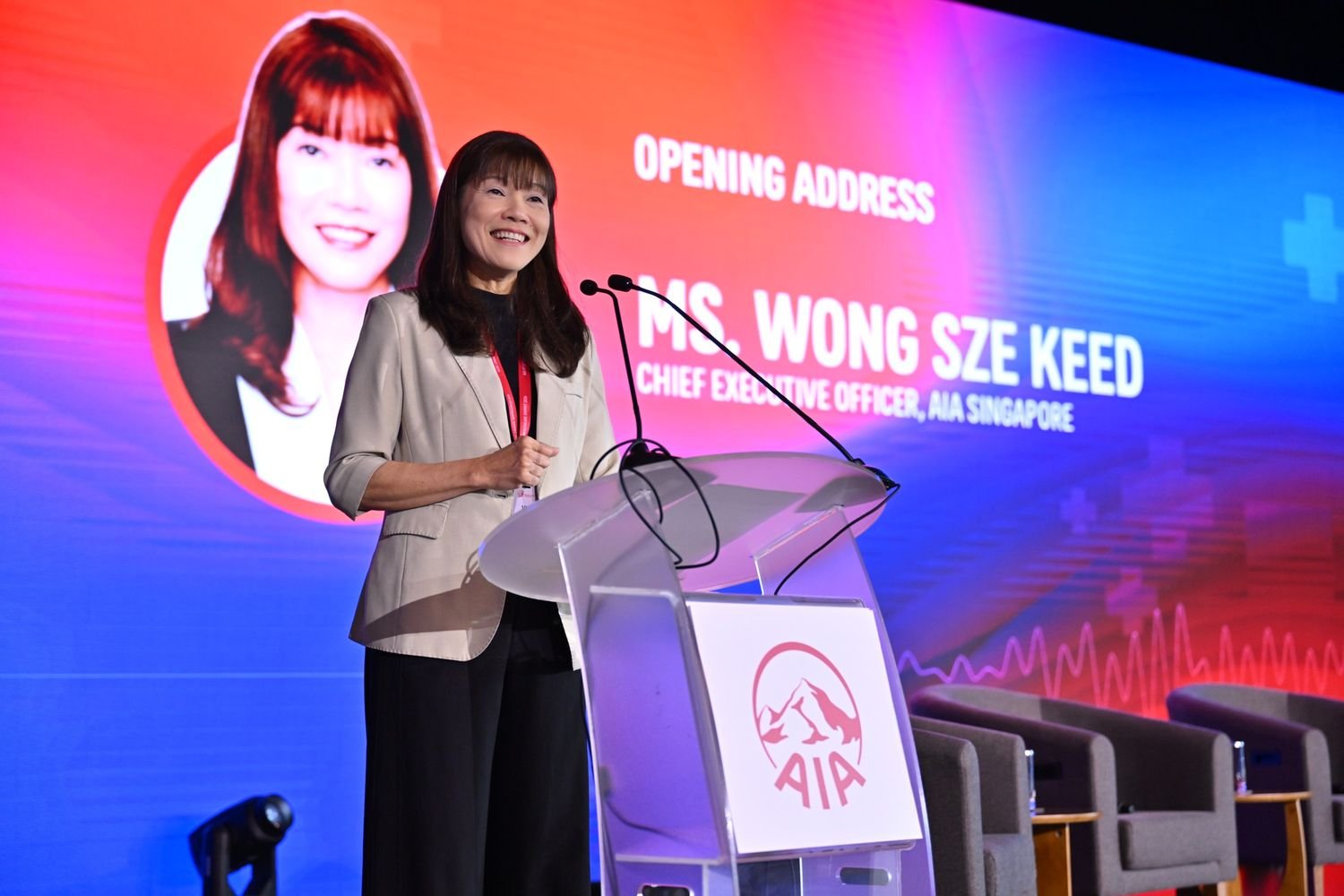
Opening Address by Ms Wong Sze Keed, Chief Executive Officer, AIA Singapore
Singapore’s healthcare system is increasingly looking beyond reactive treatment towards earlier intervention, preventive care and more continuous health management, with artificial intelligence, connected health technologies and interoperable data emerging as key tools in that transition.
At the inaugural AIA Healthcare Summit 2026, more than 700 policymakers, clinical specialists, technology innovators and corporate leaders gathered in Singapore to examine how healthcare financing, digital innovation, behavioural science and public-private collaboration could help extend healthspan as the population ages.
The summit, held under the theme “Purposeful Longevity: Advancing Holistic Health through Public-Private Partnerships”, explored how Singapore can shift from treating illness towards preventing or delaying disease, while making care more personalised and accessible.
Recent findings from the AIA Longevity Study show that Singaporeans expect to live to an average age of 80.2 years but anticipate their health beginning to decline at 70.2 years, leaving a ten-year gap between lifespan and healthspan.
Artificial intelligence, predictive analytics, precision medicine and connected devices featured prominently in discussions about how that gap could be narrowed.
A recurring theme was the need to connect fragmented health information and translate increasing volumes of data into practical actions for patients, clinicians and employers.
Kenneth Tan, Chief Corporate Solutions Officer at AIA Singapore, said fragmented health data remains a challenge across corporate health, insurance and wellness programmes.
“Many companies have highlighted the challenge of fragmented data, and at AIA Singapore, we’ve recognised this and that’s why we became the first insurer in Singapore to put all our data from corporate and individual policies together in one app. Behind this app is all of a customer’s information, sitting safe and secure, which helps us understand their whole health journey.”
He said the information could eventually support AI tools designed to guide users more continuously.
“What we can do with that information is build an AI assistant to nudge you along the way in your health journey. Right now, there are many fragmented approaches and Third-Party Administrators (TPAs) across different networks, but there is no assistant that sits across all of it to proactively guide you.”
Tan also raised the potential for broader health-data sharing between insurers and government systems.
“Right now, data sits in separate silos, the government has one system, self-managed wellness programs have another, and insurance-managed programs have their own pool.
“The question is: how do we share data at a higher level to support the Singapore workforce to build a complete health profile of the nation?”
WhiteCoat Global Founder and Chief Executive Officer Bryan Koh said continuity and coordination become increasingly important as healthcare needs grow more longitudinal, particularly for chronic disease and mental health.
“I think it’s also very important to think about how AI can actually harnesses all the meaningful health signals that we are collecting - whether that's in a normal screening result, a chronic condition creation, or a mental wellness concern– and translate it into a clear next step for the use.”
Koh said stronger interoperability could allow healthcare organisations to draw on a consolidated patient profile, reducing fragmentation as people move between different parts of the care system.
“Ultimately, what we should measure, is not how many programmes or initiatives we are rolling out, but whether the patient is getting the right level of access to support and able to continue to receive care without having to restart their entire care journey.”
The summit also explored how technology could make traditionally subjective areas of healthcare more measurable while retaining clinician oversight.
Joanna Liew, Managing Director of AiTreat and Principal Physician at NovaHealth TCM, discussed how robotics, artificial intelligence and sensors can digitise elements of traditional Chinese medicine.
“When it comes to digitising technology, it’s not about what a robot can do. Instead, it’s more about how can the robot help me in my clinical practice to make my practice more measurable, repeatable and how can I improve care for patients.”
She said technologies can quantify parameters such as treatment areas, techniques and the amount of force applied during treatment.
“It’s about pairing human judgement with machine consistency. Technology must still feel human, and people need to understand that technology empowers better care, not replaces it. Translating human expertise to make it repeatable, measurable and reviewable can make it more accessible to people to improve health outcomes.”
Wearables were another area highlighted for their role in moving healthcare further upstream.
Jörn Watzke, Senior Director at Garmin Health, said AI can help make the large volumes of information generated by connected devices more personalised and meaningful to individual users.
“Today, AI is helping us to make the offering very personalised - we have so much data but we don’t have to offer everything to every customer. The data has to be translated meaningfully and personalised to each individual.”
He added that wearable data could help identify health changes before conditions progress.
“Our body is sending signals and it is important to nail the issues earlier than later. With data from wearables, we are able to detect changes, patterns and trends in biometrics. This also allows us to move towards preventive care. We’re just scratching the surface with the data and we will see more development around this in the next phase.”
Predictive analytics could extend this approach further by combining different forms of health information to identify risks years before disease develops.
Dr Axel Baur, Chief Executive Officer of Amplify Health, said data from DNA, behavioural patterns, metabolic measurements and connected devices could increasingly be used to predict disease onset and progression.
“We are able to collect data today that allows us to see future events that are 5-10 years out. With the ability to look into DNA and behavioural and metabolic data that are collected by devices, we are able to predict onsets and progressions.”
He said earlier identification could create opportunities to intervene before chronic diseases and related conditions become established.
The role of AI in supporting access outside conventional healthcare settings was also discussed.
Zhang Yu, General Manager of the AI Insurance Services Division at Ant Health, Ant Group, highlighted the importance of usability when digital services are designed for older people.
“The elderly face many health issues so what’s most important to them is operability and usability. Between 12 midnight to 6am when outpatient clinics are typically closed in China, they can use Ant Afu as an interim consultation service to assess their condition and provide solutions. They can then make a more informed decision on when they need to go into the emergency room, or the AI platform can help them to make an appointment to see a physical doctor the next day.”
Technology was also positioned as one part of a broader move towards prevention rather than a standalone solution.
Professor Andrea B. Maier, Co-Founder of Chi Longevity, said precision geromedicine should not stop at measuring biological age, but translate information about genes, microbes, physical function and cognition into interventions that improve how people live and feel.
Workplaces were another focus of the summit, with speakers examining their role in preventive health as people work for longer.
Professor Chia Kee Seng, Professor and Founding Dean of the National University of Singapore School of Public Health, said employers have an opportunity to shape attitudes towards health during working life.
AIA Singapore Chief Marketing and Healthcare Officer Irma Hadikusuma said the longer-term value of AI will lie partly in earlier disease prediction and improving healthcare access, while maintaining the role of human involvement in care.
“Technology and AI have and will transform healthcare - they'll help us to predict disease earlier and potentially make care more accessible than ever before. But, technology cannot replace the effort that we must put in and neither can technology replace human touch. At the end of the day healthcare is still profoundly human.”