|
Hardware |
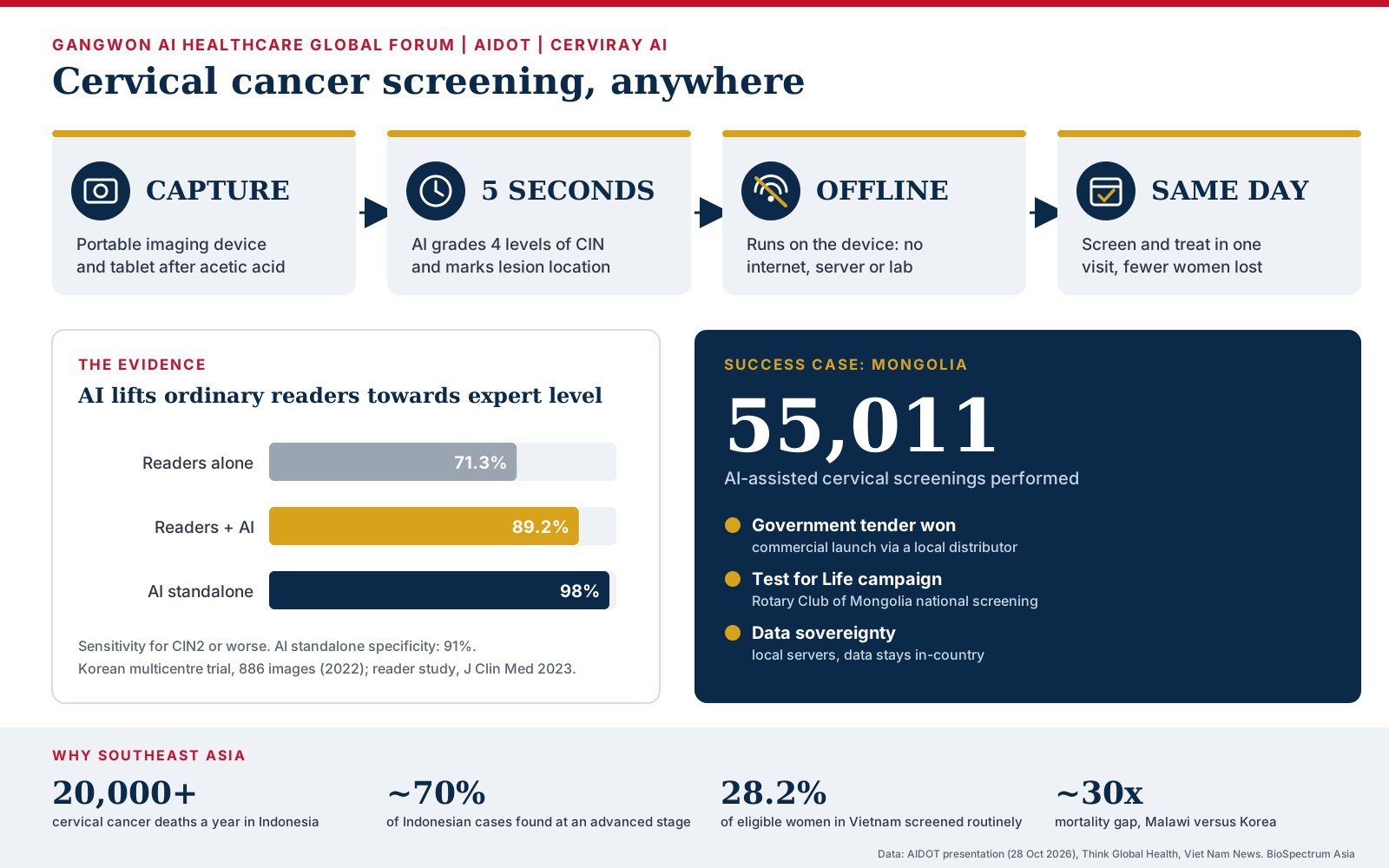
Portable cervical imaging device paired with a tablet |
|
Output |
Four-grade CIN classification with lesion location, in about five seconds |
|
Connectivity |
Runs on the device, offline: no internet, server or laboratory needed |
|
Field use |
Mongolia, Brazil and Bolivia; Indonesia (RS Hasan Sadikin); Vietnam in discussion |
The evidence so far
AIDOT points to two sets of results. In a 2022 multicentre confirmatory trial in Korea, led by Korea University Anam Hospital and covering 886 images, the AI working on its own detected CIN2 or worse with a sensitivity of 98 per cent and a specificity of 91 per cent. In a separate randomised study published in the Journal of Clinical Medicine in 2023, human readers assisted by the AI raised their sensitivity from 71.3 per cent to 89.2 per cent.
The second result is arguably the more important one. Most real-world screening will not be done by the AI alone but by health workers using it as a second pair of eyes. A system that lifts the performance of ordinary readers towards expert level is exactly what stretched health systems need.
Mongolia: from pilot to national programme
If the Korean trials are the proof of concept, Mongolia is the proof of practice. The country carries a cervical cancer burden well above Korea's: according to figures AIDOT presented, incidence is 13.1 per 100,000 women against Korea's 8.4, and mortality is 8.0 against Korea's 1.8. Cervical cancer is the fourth most common cancer among Mongolian women, and only 47 per cent of women aged 30 to 49 reported being screened in the previous five years.
AIDOT entered through a local distributor, launched commercially and won a government tender, putting Cerviray into national screening. The system was also used in the Rotary Club of Mongolia's long-running Test for Life screening campaign, which takes screening to communities across the country. The company's main clinical partner and key opinion leader there is Dr Luvsandorjiin Bayarsaikhan.
The result, by AIDOT's count, is 55,011 cumulative AI-assisted cervical screenings in Mongolia. That is real-world scale, not a pilot, and it was achieved in a country whose vast distances and dispersed population resemble the access problems found across rural Southeast Asia.
One detail from the Mongolian rollout deserves particular attention. Screening data is stored on a local server and operated in-country. For governments that are increasingly wary of sending citizens' health data abroad, that data sovereignty model may matter as much as the algorithm.
|
MONGOLIA SUCCESS CASE AT A GLANCE |
|
|
55,011 |
Cumulative cervical cancer AI screenings performed in Mongolia |
|
Tender won |
Commercial launch through a local distributor and a government procurement win |
|
Test for Life |
Cerviray deployed in the Rotary Club of Mongolia national screening campaign |
|
In-country |
Local server database: screening data stays and is operated inside Mongolia |
|
8.0 vs 1.8 |
Cervical cancer mortality per 100,000 women, Mongolia versus Korea |
Source: AIDOT presentation, 2026 Gangwon AI Healthcare Global Forum, citing GLOBOCAN, WHO and company data.
Indonesia: the beachhead
Southeast Asia's largest market is where AIDOT has moved furthest. The company entered Indonesia in 2022 through a partnership with Pyridam Farma, a listed Indonesian pharmaceutical company, and has since obtained an AKL distribution permit from the Ministry of Health for Cerviray. It also completed a prospective clinical study of more than 300 cases with senior Indonesian clinicians, with the results published locally.
In June 2026, AIDOT announced that Cerviray had been adopted at RS Hasan Sadikin in Bandung, one of the Ministry of Health's three major national teaching hospitals. The choice of entry point is strategic. Teaching hospitals train the doctors and midwives who staff Indonesia's provincial hospitals and its network of puskesmas, the community health centres where most women would actually be screened. Winning the trainers is a route to the trainees.
The policy environment is supportive but demanding. Indonesia's National Cervical Cancer Elimination Plan, launched in 2023, commits the country to screening 75 per cent of women aged 30 to 69 and to expanding treatment services across all 514 districts by 2030. Free screening is now offered on citizens' birthdays under the Cek Kesehatan Gratis programme launched in February 2025. At the same time, the national programme has shifted its high-performance standard from VIA to HPV-DNA testing, which shapes where an AI-assisted VIA tool fits.
Vietnam: the next door opening
Vietnam has just raised its ambitions. In August 2026, the Ministry of Health unveiled a national action plan for 2026 to 2035 aimed at eliminating cervical cancer, adopting the WHO targets of vaccinating 90 per cent of girls against HPV, screening 70 per cent of women aged 30 to 49 with high-performance tests and treating 90 per cent of women found to have lesions. With screening coverage starting from under 30 per cent, the gap to close is enormous.
AIDOT's Vietnam effort is earlier stage. The company exhibited at the Vietnam K-Medical Device Exhibition in Ho Chi Minh City in June 2026 as part of a Gangwon pavilion organised by the Wonju medical device promotion agency with the National Health Insurance Service and Gangwon Technopark. During that mission, the company discussed a possible three-month free clinical test with Tam Anh General Hospital, which was reported as under consideration. Jeong has spoken of strong interest from regional buyers.
The questions Southeast Asia will ask
From Chuncheon to the world
AIDOT's story fits a wider pattern at this year's forum. Gangwon is positioning itself as Korea's AI healthcare test bed, and its companies are increasingly measured not by what they can build in a lab but by what they can deploy in the field. Cerviray's journey, from a confirmatory trial in Seoul to tens of thousands of screenings on the Mongolian steppe and a national teaching hospital in Bandung, is exactly the kind of real-world impact the forum set out to showcase.
For Southeast Asia, the opportunity is significant. The region has the burden, the elimination targets and a growing willingness to adopt digital health. What it lacks is enough trained eyes in enough places. If an offline algorithm on a tablet can give a nurse in a rural clinic the judgement of an experienced gynaecologist, the map Jeong showed in Chuncheon could start to look very different.
Note: Clinical performance, deployment and Mongolia figures are as presented by AIDOT at the 2026 Gangwon AI Healthcare Global Forum on 28 October 2026 and in company announcements, and have not been independently audited. Country burden figures are from published national and international sources. Information current as of 28 October 2026.