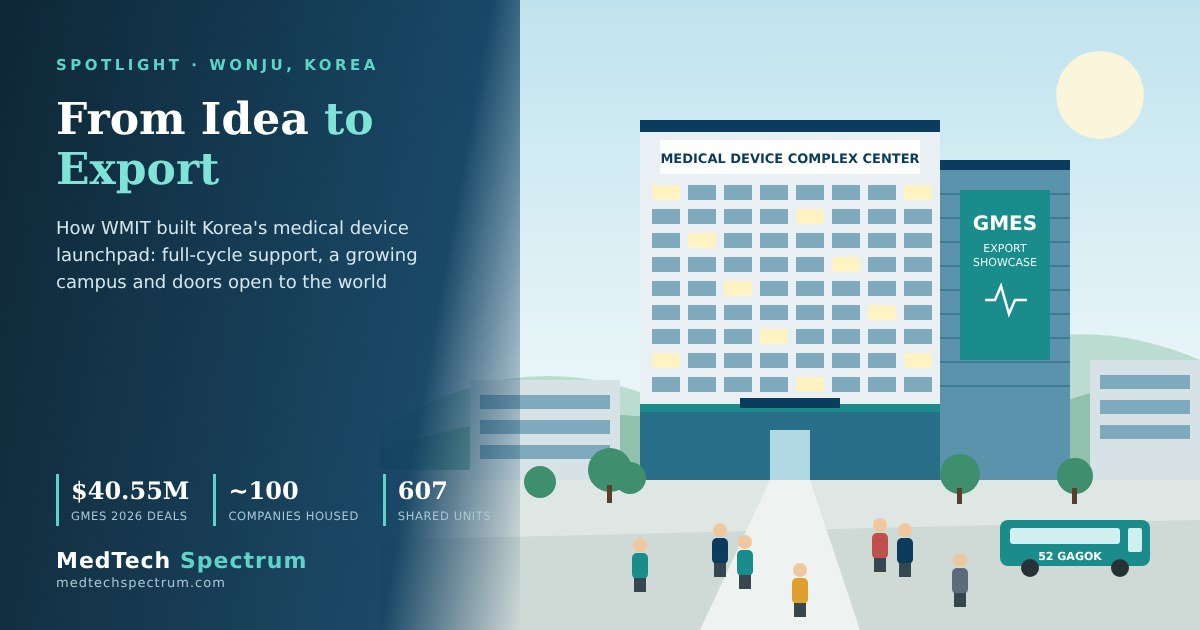
With record trade results, an expanding campus and an increasingly global footprint, WMIT is positioning Wonju as one of Asia's most complete homes for medtech enterprise.
|
WMIT at a glance Who: Wonju Medical Industry Institute of Technology (WMIT), Korea's dedicated medical device industry support institution, founded in 2003 Where: Medical Device Multi Complex Center (MCC), Wonju Enterprise City, Gangwon State Model: MEDISTRY: full-cycle support from first idea to global export Footprint: Three sites housing close to 100 enterprises; 607 equipment units across 209 types Market engine: GMES 2026 signed a record USD 40.55 million in export contracts Global reach: Joint pavilions at seven international exhibitions on three continents Leadership: Kim Young-sung, 10th President (since April 2026) |
Medical devices are among the hardest products to commercialise. A promising design must survive safety testing, electromagnetic compatibility checks, quality audits, national approvals, reimbursement negotiations and, finally, the long search for distributors in markets with very different rules. For small and mid-sized manufacturers, each step can mean a new agency, a new city and a new invoice. Many good products stall somewhere in that chain.
WMIT exists to remove that friction. Backed by Wonju City and Gangwon State, and working alongside national bodies including the Ministry of Trade, Industry and Energy, the Ministry of Health and Welfare, the Ministry of Food and Drug Safety and the Ministry of Science and ICT, the institution has built testing, certification, production, exhibition and export services into one campus and one team. Its stated ambition is to establish a global cluster leading the medical and healthcare industry, and its track record suggests the ambition is grounded.
WMIT calls its approach MEDISTRY, a blend of medical and industry. It is a customised, full-cycle support system designed for enterprises at every stage, from pre-founders still validating an idea to established firms aiming to become global small hidden champions. The principle is simple: a company should be able to find every form of help it needs in one place, delivered by people who already know its file.
The table below sets out how that support works in practice, stage by stage.
|
Stage |
What WMIT provides |
What it means for the enterprise |
|
1. Idea |
Idea consulting backed by multilateral analysis of prior technology |
Founders see the patent and competitive landscape before committing capital |
|
2. Design and prototype |
Design, planning and prototype manufacturing that reflect demand from clinical users; access to shared equipment |
Faster, cheaper iterations without buying specialised kit |
|
3. Testing and inspection |
UL-designated testing laboratory (2013) and an electromagnetic compatibility chamber (2016) on campus |
Safety and EMC testing done in-house, cutting weeks of external lead time |
|
4. Certification and quality |
International Medical Device Certification Support Center (2022) and a GMP audit certification advisory group (2021) |
A clearer, guided route to domestic and overseas approvals |
|
5. Regulation and reimbursement |
Designated education institute for medical device regulatory science; RA forums with US, EU and Japan experts; HIRA reimbursement consulting at GMES and KIMES |
Regulatory and pricing strategy planned in parallel with product development |
|
6. Production space |
Leased factory floors across three sites, through a simple five-step move-in process |
Room to scale manufacturing next door to testing and support services |
|
7. Domestic market |
Year-round permanent exhibition halls and the annual GMES with one-to-one buyer matching |
Constant visibility to buyers, hospitals and delegations |
|
8. Global export |
Joint pavilions abroad covering booth, build, interpretation, directories, buyer mailers and media; follow-up support on distributors and licensing |
A small firm can enter major markets looking like a seasoned exporter |
The real strength of the model is continuity. Because the stages are delivered on the same campus, a design change prompted by an EMC result can be retested within days, and a company that has passed certification can step straight into a buyer meeting downstairs. That continuity shortens time to market, lowers cost and reduces the risk that a viable product is abandoned halfway.
The centrepiece of the system is the Medical Device Multi Complex Center (MCC), a ten-storey building in Wonju Enterprise City completed in 2013. With 31,968 square metres of floor space, it is organised like a vertical value chain. The first two floors hold 4,693 square metres of permanent medical device exhibition halls. Technical support and equipment facilities occupy around 11,900 square metres and house 607 units across 209 equipment types, available to enterprises that could never justify owning such equipment themselves. Floors four to ten provide more than 15,300 square metres of leased factory space for 56 tenant companies, supported by conference facilities, a 300-seat cafeteria and a five-tonne freight lift.
Two further sites extend the campus. The Wonju Medical Device Industry Technology Park offers just over 24,000 square metres across four buildings for 34 tenants, while the Donghwa Medical Devices Factory hosts eight more. Around this core, WMIT also operates G-Medical Hub, an online platform launched in 2021 to connect Korean manufacturers with global buyers, and a digital studio opened in 2022 for online business meetings and product launches.
WMIT's growth has been steady and deliberate. In 1999 the first Wonju medical device industrial technology complex opened with 18 tenant companies. Today the institution's three sites house close to a hundred enterprises, and its programmes reach many more firms across Gangwon and the rest of Korea. Just as important as the physical growth has been the steady addition of capability, regulatory status and national mandates.
|
Year |
Milestone |
|
1998 |
Biomedical instrumentation and rehabilitation engineering research centre selected in the region |
|
1999 |
First Wonju medical device industrial technology complex opens with 18 tenant companies |
|
2003 |
WMIT formally established |
|
2004 to 2006 |
Donghwa medical device complex completed; high-tech medical health industry special zone (2005); first GMES, then called Gangwon Medical Plaza (2006) |
|
2013 |
Ten-storey Medical Device Multi Complex Center completed; UL testing laboratory designation |
|
2016 to 2019 |
EMC chamber; Gangwon digital healthcare regulation-free special zone; regulatory science education institute |
|
2020 to 2022 |
Korea's first digital healthcare security living lab; G-Medical Hub platform; International Medical Device Certification Support Center |
|
2024 to 2025 |
National platform for K-medical global market entry; digital twin medical innovation project; first CES pavilion; record Arab Health result; renamed Wonju Medical Industry Institute of Technology |
|
2026 |
Selected to build global commercialisation foundations for AI convergence aesthetic devices and to help develop standards for AI-based active assisted living; record GMES; new Southeast Asia missions |
The most recent mandates show where the next wave of growth will come from. The national platform for K-medical global market entry, awarded in 2024, now underpins much of WMIT's overseas pavilion work. The 2026 selections on AI convergence aesthetic devices and AI-based active assisted living position the institution at the meeting point of three high-growth themes: artificial intelligence, aesthetics and technology for ageing societies. National recognition has followed, including a ministerial commendation in November 2025 as an outstanding bio-specialised centre.
Clusters often become closed communities. WMIT has deliberately done the opposite, opening its doors to new enterprises, buyers, the public and international partners.
Open to new enterprises. Joining the campus follows a clear five-step process: an initial counselling session, submission of an application, a review, notice of approval, and finally the tenancy contract and move-in. The counselling stage lets a company, domestic or foreign, understand space, services and fit before committing.
Open to buyers all year. The permanent exhibition halls on the MCC's ground floors keep Wonju's products on show year round, so visiting buyers, hospital purchasers and delegations can compare devices from many manufacturers in one visit, without waiting for a trade show.
Open to the public at GMES. The Gangwon Medical Equipment Show, held in the same halls each September, balances serious trade with public engagement. In 2026 a Smart Medi Home zone, built like a show flat, demonstrated devices in everyday living, while a weekend discount event with seven local companies welcomed general visitors alongside international buyers.
Open to the world. WMIT has signed cooperation agreements with partners in Germany, including the state of Saarland and the Biosaxony association in Saxony, and runs joint pavilions at seven international exhibitions on three continents.
|
Exhibition |
Market |
WMIT support package |
|
KIMES |
Seoul, Korea |
Gangwon Pavilion of 55 booths (603 sq m) for 2026, interpreters, directory, buyer mailers, media and overseas buyer invitations |
|
CES |
Las Vegas, USA |
Wonju Pavilion of eight booths since 2025, booth fees and build, directory and CES Innovation Award application support |
|
World Health Expo |
Dubai, UAE |
276 sq m pavilion, buyer matching, booth administration, pre and post-event media |
|
MEDICA |
Düsseldorf, Germany |
84 sq m pavilion, booth, registration and construction, English and German interpretation |
|
Vietnam Medi-Pharm |
Hanoi, Vietnam |
Joint pavilion since 2024 with shell scheme booths, directory and interpreters |
|
COSMOPROF Asia |
Hong Kong |
12-booth pavilion for aesthetic and skin-care device makers, buyer matching and media |
|
Hospital Expo |
Indonesia |
Joint pavilion since 2025, booth administration, directory and buyer mailers |
Across these pavilions, exhibitors typically cover their own travel and shipping plus a share of participation or construction fees, while WMIT absorbs much of the organisational burden and cost. The result is that a ten-person company can present itself at MEDICA or the World Health Expo with the polish of a far larger exporter.
GMES is the clearest measure of WMIT's commercial impact. Co-organised with KOTRA's Gangwon office and the National Health Insurance Service, and hosted by Gangwon State and Wonju City, the show has grown steadily in value.
|
Year |
GMES export contracts |
|
2022 |
USD 17.55 million |
|
2023 |
USD 20.64 million |
|
2024 |
USD 24.69 million |
|
2025 |
USD 36.14 million |
|
2026 |
USD 40.55 million (record) |
The 2026 edition, held on 3 and 4 September, brought together 147 domestic and international companies and institutions and around 140 invited buyers. It passed its KRW 36.3 billion target on the opening day. Skin-care and aesthetic devices, AI-based body composition analysers and hyperbaric oxygen therapy systems led the deals, with established Gangwon manufacturers such as Neo Biotech, Bio-Protech, Mediana and CU Medical Systems exhibiting alongside rising innovators including IBEX Medical Systems, a recent winner of the IR52 Jang Young-sil Award. Organisers credit the result to pre-event online export consultations and one-to-one company and buyer matching, which turn conversations into contracts.
The overseas programme is delivering too. At Arab Health 2025 in Dubai, the Gangwon Joint Pavilion brought 24 companies and signed USD 9.35 million in on-site contracts, WMIT's best result at that show. In 2026 the institution pushed deeper into Southeast Asia. Its first market exploration delegation to WHX Bangkok took ten companies and combined the exhibition with visits to hospitals and industry associations. In Ho Chi Minh City it opened talks with leading Vietnamese hospitals on clinical testing of an AI diagnostic solution. At Hospital Expo 2026 in Indonesia, six enterprises held 44 business consultations worth USD 3.25 million, closed four contracts worth USD 655,000 and signed MOUs and letters of intent with local partners. President Kim Young-sung said the Indonesian results confirmed Korean firms can compete on technology despite localisation rules and entry barriers.
WMIT's leadership has signalled two clear priorities. The first is helping device companies through the AI transformation of their products, building on the institution's new national roles in AI aesthetic devices and active assisted living standards. The second is stronger follow-up after every exhibition, from distributor discovery to licensing cooperation, so that more consultations become signed contracts and lasting market positions.
Both priorities play to the institution's core strength: the ability to support an enterprise continuously, rather than in isolated programmes.
For medtech enterprises in Korea and abroad, WMIT offers testing, certification, regulatory guidance, production space and export marketing in one connected system, reducing cost and time to market.
For international buyers and distributors, GMES and the year-round showroom provide efficient access to a concentrated pool of export-ready Korean manufacturers, backed by an institution that supports follow-up.
For governments, hospitals and cluster partners, WMIT's journey from 18 tenants in 1999 to a nationally mandated hub is a proven model for building a medical device industry from the ground up, and an open partner for collaboration.
In a global market where speed, compliance and credibility decide who wins, WMIT has built a rare advantage: everything an enterprise needs, in one place, and a door that is always open.
|
Connect with WMIT • Address: Medical Device Multi Complex Center, 200 Gieopdosi-ro, Jijeong-myeon, Wonju-si, Gangwon, Republic of Korea 26354 • General enquiries: +82 33 760 6100 • Global Marketing Team: +82 33 760 6137 (GMES, KIMES), 6134 (WHX, MEDICA, Vietnam), 6138 (CES, Indonesia), 6139 (COSMOPROF Asia) • Online: www.wmit.or.kr/eng, gmes.wmit.or.kr and www.g-medicalhub.com |