Women's healthcare is undergoing a digital transformation as artificial intelligence, telemedicine and data-driven care models begin addressing long-standing gaps in access, continuity and personalised treatment. While advances in AI have reshaped multiple areas of healthcare, women's reproductive and gynaecological health has historically remained underserved, constrained by limited specialist access, social stigma and fragmented care pathways. Today, AI-powered digital clinics are emerging as a promising solution, enabling timely consultations, improving clinical decision-making and extending specialist care to women across urban and underserved regions alike.
Among the innovators driving this shift is Pinky Promise, an AI-enabled women's healthcare platform that has facilitated more than 400,000 consultations across India. By combining protocol-driven artificial intelligence with clinician oversight, the platform is helping bridge access gaps while ensuring patient safety, privacy and continuity of care. Its chat-first approach is also encouraging more women to seek professional medical advice for sensitive reproductive health concerns, many for the first time.
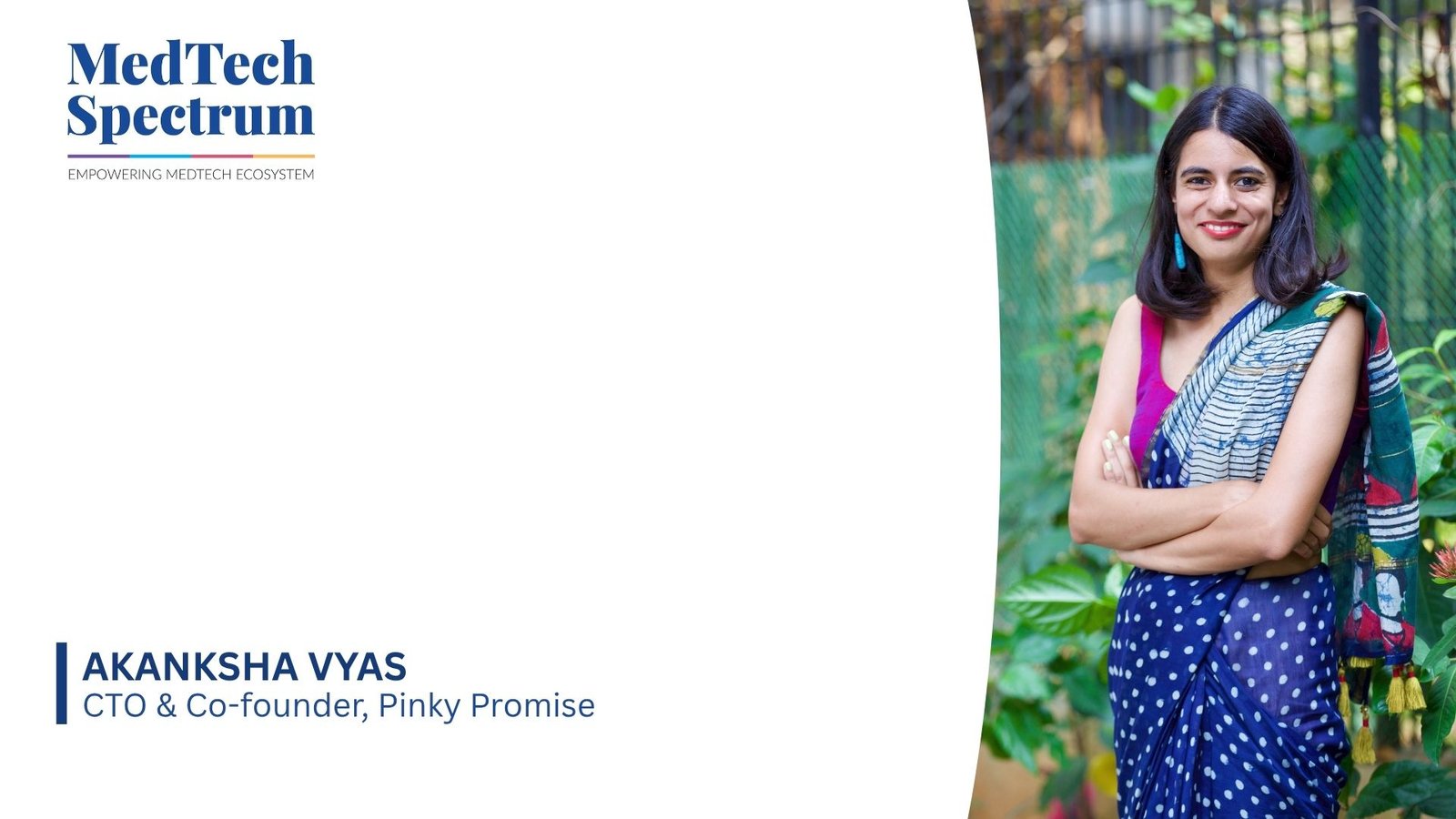
In an interaction with MedTech Spectrum, Akanksha Vyas, CTO and Co-founder of Pinky Promise, shares how AI is transforming women's healthcare beyond pregnancy, the role of clinician-guided AI in improving diagnosis and patient engagement, the importance of privacy-first digital care, and how predictive intelligence and personalised care could redefine reproductive healthcare over the coming years.
Pinky Promise has now delivered over 4,00,000 women's health consultations across India. Based on this experience, what are the most significant gaps or “blind spots” in women’s healthcare that traditional healthcare systems continue to overlook?
The clearest blind spot is that women's healthcare has been built almost entirely around pregnancy, while the rest of a woman’s reproductive life is left largely unattended. Menstrual health, hormonal conditions, PMOS, contraception and general gynaecological wellbeing tend to be treated as secondary concerns, something to be dealt with only once they become urgent. The reality is that so many women deal with chronic conditions starting from puberty. Roughly half the women who come to Pinky Promise are consulting a gynaecologist for the very first time, and many of them are adults who have been managing conditions such as PMOS or recurrent infections quietly for years, without any professional input.
The second gap is structural. India has close to 360 million women of reproductive age and only around 70,000 registered gynaecologists, most of them concentrated in the metros. A woman in a smaller town often has to travel for hours, arrange childcare and take time off work just for a first consultation, and traditional clinic hours rarely account for when women actually need care, including late nights and weekends.
The third is continuity of care. Traditional healthcare is built around isolated consultations, whereas many women's health conditions such as PMOS, endometriosis, fertility concerns and hormonal disorders require ongoing monitoring and long-term management. Women often leave a clinic with a prescription but little structured follow-up. Healthcare needs to move from treating episodes to supporting women throughout their reproductive lives.
Your platform combines protocol-driven AI with clinician oversight rather than replacing doctors. Could you explain how the AI supports clinical decision-making and what safeguards are built into the system to ensure accuracy, transparency, and patient safety?
We have built AI systems that work alongside the Doctor, take care of the time consuming parts of the consultation and help them focus on their medical expertise. The AI helps them ask the patients the right medical questions, suggest a diagnosis and prescription to them and also suggests answers to followup questions. In this way, the AI systems work as an assistant to the Doctor, and no medical information is ever shared with a patient directly from the AI systems.
Alongside this, we have designed the system for escalation rather than automation. A healthcare product should never be optimised purely for speed, it has to know when to pause, ask more questions or route a case to urgent offline care. We have built pathways that flag risk indicators, ambiguous symptoms and severe presentations, and these are escalated immediately rather than processed further by the AI.
On the safety and transparency side, all patient data is stored on our own servers and never leaves them. Any data used for model improvement is anonymised, with personally identifiable and medical information removed before it is processed. Patient records are encrypted both at rest and in transit, and access is restricted to the treating doctor. Every clinical recommendation generated by the platform is reviewed and approved by a qualified gynaecologist before it reaches the patient. These safeguards are fundamental because trust and patient safety are non-negotiable in healthcare.
Privacy and stigma remain major barriers to seeking care for sexual and reproductive health. How has the chat-first digital care model influenced patient behaviour, and what trends have you observed in terms of consultation patterns, openness, and treatment adherence?
Early on, my co-founder Divya ran an experiment where she mimicked a chatbot in WhatsApp and Facebook groups, asking women the same medical questions in text and then following up by phone to ask them again. Women were consistently more forthcoming over chat than on a call. They disclosed things they had not mentioned in the verbal conversation, symptoms they considered embarrassing, medications they had taken, concerns they had been carrying privately for a long time. We call this the honesty gap. It affects whether a doctor works from a full clinical picture or from partial information that may miss something important. It also deeply impacts how much a woman trusts her prescription.
That pattern has held up at scale. Roughly half our users are consulting a gynaecologist for the first time in their lives, often well into adulthood, and many are managing conditions like PMOS or recurrent infections that were never properly diagnosed. The questions that come through most consistently at odd hours, particularly around two in the morning, tend to involve emergency contraception, vaginal discharge or itching, and general questions about whether something is normal. These carry a weight of hesitation that has very little to do with the medical complexity of the question and a great deal to do with how little space women have historically had to ask it out loud.
Our three month customer retention rate stands at 97.4 percent, which tells us that once a woman experiences care that genuinely feels private and non-judgmental, she comes back and stays engaged with follow ups and ongoing treatment rather than disappearing after a single consultation.
Women's healthcare has historically received limited attention in AI innovation. What technical and clinical challenges did your team encounter while building AI models specifically for gynaecology, and how do these differ from AI applications in other medical specialties?
The first challenge was around model architecture. We decided against building simply on top of a general purpose medical language model, because women’s health could not be treated as a smaller subset of general medicine. The conditions, the stigma around them, the way symptoms present and the way patients describe them are specific enough that they needed models trained specifically for this domain. So we built our own clinical AI models trained on more than 10,000 sources, including over 250 clinical protocols, peer reviewed literature and contributions from senior gynaecologists, and we use large language models purely as a language layer to personalise how each patient is communicated with.
The second challenge was linguistic and deeply local. Women typing about a health concern from a smaller town are often mixing Hindi and English in the same sentence, using Roman script for both, and switching without thinking about it. Sexual and reproductive health also carries euphemisms and terms that differ from district to district, shaped by stigma that varies with geography. We pressure tested our medical questions with more than 10,000 women across India to make sure the language we use is simple and clear regardless of where a patient is typing from.
The third challenge is the underlying data gap. Women were excluded from clinical trials until as late as 1993, and most clinical AI tools available today were trained on data that skews predominantly male. That bias shows up in how women get diagnosed and treated across virtually every medical domain, and correcting for it in gynaecology specifically meant treating our data as a clinical asset built with care, drawing on real cases, doctor input and validated protocols, rather than simply optimising for volume.
With support currently available in Hinglish and English across Tier I, II, and III cities, how do you see AI-powered digital clinics helping bridge healthcare access gaps in underserved regions? What role can such platforms play in enabling preventive care rather than reactive treatment?
India’s core healthcare constraint is distribution rather than talent. The country has capable doctors, but their expertise is concentrated in metros and large cities, while demand is spread across every district. AI can act as a genuine multiplier here. It can structure a consultation, prioritise cases and surface the right clinical pathway at the right time, which allows a single qualified gynaecologist to support far more patients without any compromise in the quality of her clinical engagement. A doctor who might see thirty to forty patients a day in a clinic can support many times that number through our model, because the repetitive parts of intake and documentation are absorbed by the system, leaving her time for the clinical thinking that actually requires her judgment.
For this to genuinely serve Tier II and Tier III India, language cannot be an afterthought. Support in Hinglish and English is a starting point, and we are actively expanding into more Indian languages, because a woman’s comfort in describing her symptoms in her own words directly affects how much a doctor can understand and act on.
On preventive care, the bigger opportunity is moving the starting point of healthcare much earlier. Most women, including women in my own family, have historically been reactive about their health, engaging with the system only once a condition becomes urgent. A chat-first digital clinic that is available at any hour removes much of the friction that keeps a woman from raising a concern early, whether that is finding time, travelling to a clinic or simply working up the courage to ask. Over time, continuous rather than episodic engagement means patterns can be identified sooner, which is exactly what preventive care requires.
Looking ahead, how do you envision AI transforming women's healthcare over the next five years? Do you see technologies such as multimodal AI, predictive diagnostics, remote monitoring, or personalized care assistants becoming integral to reproductive and gynaecological care?
The shift I expect over the next five years is from episodic care to continuous, longitudinal care. Today, most women engage with the healthcare system only when something has already gone very wrong. The opportunity ahead is to use AI to interpret symptoms, identify risks early and personalise guidance based on a woman’s ongoing health profile rather than a single visit, so that clinicians can intervene before a manageable condition becomes a serious one. We have already seen early signs of what this looks like in practice, including women conceiving after years of managing undiagnosed endometriosis and cases of early cervical cancer detection through our platform.
Predictive diagnostics and personalised care assistants will likely become standard rather than novel over this period, particularly for chronic gynaecological concerns such as PMOS, fertility support and hormonal health, where ongoing management matters more than a single consultation. We are building systems where all your health records, across text, images, lab reports and other patient inputs are in one place and interpreted by our AI systems to create complete case histories for every patient. Health and fitness tracking devices will significantly help us build truly personalized care for more chronic conditions.
However, the most important shift I am hoping for is in the data itself. Women’s health has always lacked the scale and specificity of clinical data that other fields take for granted. Platforms like ours are in a position to help close that gap, both for patients directly and by building tools and data infrastructure for doctors and the wider healthcare ecosystem, so that women’s health finally has the clinical intelligence and evidence base it has always deserved.