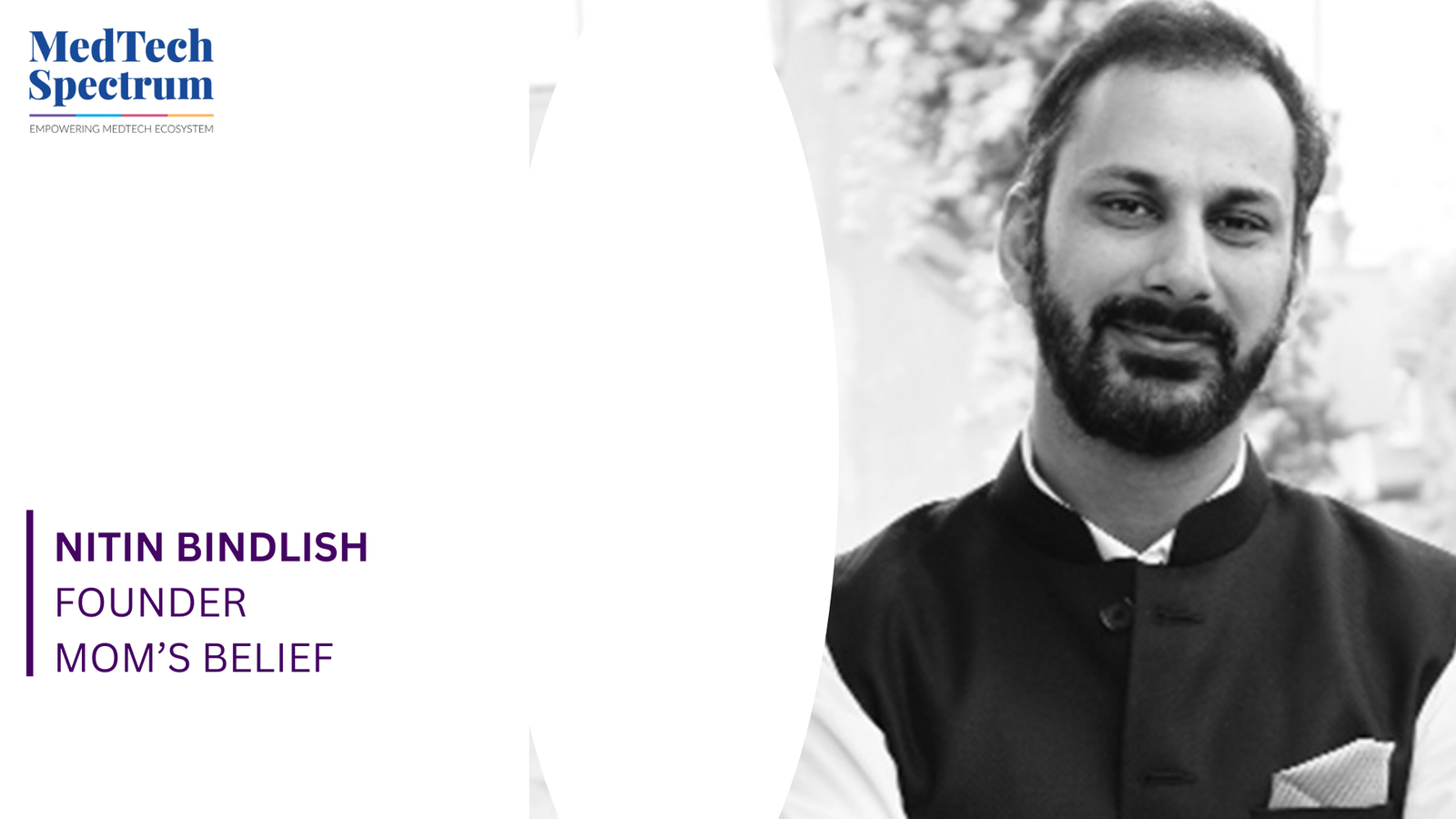
As India confronts a widening gap in structured neurodevelopmental disorder (NDD) care, scalable and system-oriented solutions are becoming increasingly critical. Nitin Bindlish, Founder of Mom’s Belief, has positioned the organisation as India’s only Social Enterprise in neurodevelopmental care under the SEBI (ICDR) framework, with a focus on formalising and expanding access to early intervention services nationwide.
With a network of 136 centres across 57 cities, including Tier 2 and Tier 3 towns, Mom’s Belief combines standardised clinical protocols, caregiver-led intervention models, community health linkages and structured assessment frameworks to address fragmentation in the NDD ecosystem. Backed by 339+ full-time clinical professionals and the use of globally recognised tools such as Pearson Clinical Assessments and CARS, the organisation seeks to integrate operational scalability with measurable social outcomes.
In this interview with MedTech Spectrum, Nitin Bindlish discusses the rationale behind operating as a for-profit social enterprise, the impact of its “Parent-as-a-Co-Therapist” approach, early identification initiatives with ASHA and ANM workers, and the role private capital can play in formalising and strengthening India’s neurodevelopmental care infrastructure.
Mom’s Belief describes itself as India’s only Social Enterprise in neurodevelopmental care. How does this model differ from traditional therapy centres and why is a social enterprise structure particularly suited to addressing the NDD care gap in India?
We operate as a for-profit social enterprise as defined under Regulation 292E of the SEBI (ICDR) Regulations. In simple terms, this means our core operating model is designed around a clear social objective and requires us to demonstrate measurable alignment between our activities and social outcomes.
How this differs from a traditional therapy-centre model is not only pricing or CSR. It is the operating philosophy:
A social enterprise structure fits India’s NDD gap because it keeps the organisation focused on scale, access, and ecosystem integration while maintaining operational discipline and long-term sustainability.
Your “Parent-as-a-Co-Therapist” approach integrates therapy into a child’s natural environment. How does this model improve developmental outcomes while reducing the psychological burden often associated with clinical interventions?
Our view is straightforward: in NDD care, the child’s progress depends heavily on what happens between sessions—at home, in school and in daily routines. A purely clinic-led approach can help, but it cannot carry the full load at population scale, particularly given workforce constraints.
The Parent-as-a-Co-Therapist approach is designed to do two things:
We are careful not to overclaim outcomes in public communication, but the intent is clinically grounded: greater consistency, better generalisation of skills across settings and a more empowered family system.
With a 136-centre footprint across 57 cities, including Tier 2 and Tier 3 towns, what operational and technological strategies have enabled you to scale specialised NDD care beyond urban hubs?
As disclosed in the UDRHP, we scaled to 136 centres across 57 cities (including Tier 2 and Tier 3 locations). Scaling specialised care beyond metros requires both operational repeatability and thoughtful standardisation.
Operational strategies:
• Standardised centre playbooks and SOPs: Clear protocols for centre setup, service delivery, documentation, supervision and parent communication reduce variability as we expand into new micro-markets.
• Hub-and-spoke clinical support: Senior clinical leadership and specialised expertise can be structured to support multiple centres, so smaller towns are not forced to operate in isolation.
• Workforce planning: Maintaining a defined role mix and supervision cadence is essential when operating across many locations.
Technology-enabled strategies (as supportive enablers, not replacements):
• Structured home programs and remote parent guidance: Digital tools are most useful when they extend caregiver coaching and continuity, particularly where access to specialists is limited.
• Measurement and documentation discipline: Consistent tracking strengthens quality and comparability across geographies, which supports both clinical governance and scalability.
You’ve initiated large-scale training programs for ASHA and ANM workers. How critical is early identification in improving long-term outcomes, and what systemic gaps are you addressing at the primary healthcare level?
Early identification is critical because the earlier a child enters a structured support pathway, the more effectively families can address avoidable delays in communication, learning readiness, behaviour support and day-to-day functioning. Delayed identification often leads to compounded challenges, including long periods of uncertainty and inconsistent care.
As disclosed in the UDRHP, we have initiated large-scale training programs for frontline workers—particularly ASHA and ANM workers—to strengthen early identification and to help families understand early intervention and available government support systems.
At the primary healthcare level, the systemic gaps we aim to address include:
• Low awareness of early signs of neurodevelopmental challenges at frontline touchpoints
• Weak referral pathways from community identification to credible assessment and intervention
• Limited navigation support for families to access entitlements and structured services
This is not about substituting specialists; it is about building a stronger “front door” so children are identified earlier and connected to the right next step.
With 339+ full-time clinical professionals and the use of gold-standard tools such as Pearson and CARS assessments, how do you ensure clinical excellence while maintaining scalability and affordability?
As of Sept 30, 2025, we disclosed 339 full-time clinical professionals (within 517 permanent employees). Clinical excellence at scale depends on standardisation, supervision and measurement.
Key elements:
• Structured assessments: We have disclosed the use of standardised tools including Pearson Clinical Assessments and CARS, as well as other widely used frameworks. The purpose is to reduce subjectivity, strengthen diagnostic quality, and translate findings into structured intervention plans.
• Personalised care plans with clear goals: Assessments are meaningful only when they become actionable plans tailored to a child’s sensory, cognitive, behavioural and communication profile.
• Training, supervision and documentation discipline: Scalable clinical delivery needs consistent training and ongoing oversight across centres.
• Affordability through operating design: Sustainability is driven less by discounting and more by repeatability—consistent processes, appropriate role mix, and reducing avoidable rework through better assessment and tracking.
As a SEBI-registered, IPO-bound Social Enterprise, how do you balance financial sustainability with social impact, and what role can private capital play in formalising and organising India’s fragmented NDD ecosystem?
As a for-profit social enterprise identified under the SEBI (ICDR) framework, our impact orientation is not an informal narrative; it is embedded in compliance and disclosure expectations. The balance is achieved by designing impact delivery into the core operating engine, while maintaining financial discipline so the model remains durable and scalable.
In practical terms, we aim to balance:
• Impact through the core model: access expansion into underserved geographies, early identification linkages, caregiver enablement, structured home programs, and school collaborations.
• Sustainability through operating discipline: standardised processes, clinical governance, and a scalable workforce model.
Private capital can play a constructive role in formalising and organising India’s fragmented NDD ecosystem by enabling:
• Standardisation and quality systems (training, clinical governance, measurement)
• Capacity creation (workforce development and centre expansion with defined protocols)
• Responsible technology enablement to extend access and continuity
The broader goal is ecosystem-building—so quality neurodevelopmental care becomes reliable and accessible, rather than accidental or privileged.