Photodynamic therapy (PDT) has long been recognised as a promising cancer treatment due to its ability to selectively destroy cancer cells while minimising damage to surrounding healthy tissue. However, its clinical adoption for deep-seated and hard-to-reach tumours has been limited by one fundamental challenge: delivering light precisely to internal treatment sites. Advances in wireless bioelectronics and implantable photonic technologies are now opening new possibilities for overcoming this barrier and expanding the reach of targeted cancer therapies.
Researchers at the University of Glasgow have developed a battery-free, implantable wireless micro-LED platform designed to enable light delivery directly to tumours located deep within the body. The flexible bioelectronic system combines wireless power transfer with photodynamic therapy, offering a minimally invasive approach that could improve treatment outcomes for bladder cancer and potentially other cancers, including ovarian and prostate malignancies. The technology has demonstrated successful light transmission through tissue-mimicking models and represents a significant step toward more precise, patient-friendly cancer treatment.
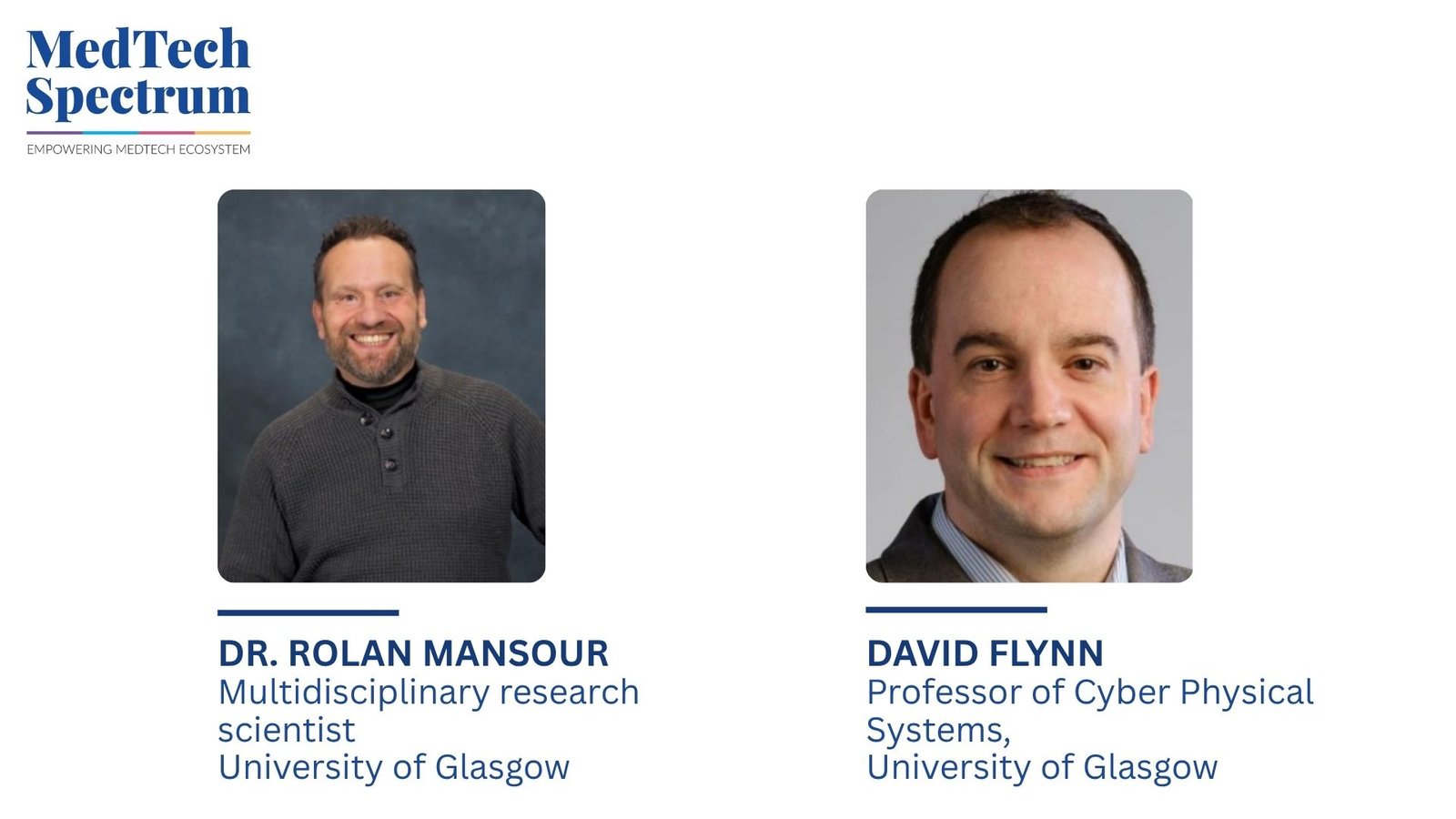
In this exclusive interview with MedTech Spectrum, Professor David Flynn, Professor of Cyber Physical Systems, and Dr Rolan Mansour from the University of Glasgow's James Watt School of Engineering discuss the inspiration behind the technology, the role of wireless bioelectronics in transforming cancer care, the challenges that remain before clinical translation, and how implantable photonic devices could shape the future of precision oncology.
What inspired the development of this implantable wireless micro-LED platform, and what key clinical challenges in bladder cancer treatment were you aiming to address through this technology?
The inspiration was built on the vision of creating a technology to address a frontline clinical gap in cancer treatment, with minimal side effects for patients. We chose to use a technology that is both affordable and easily accessible in terms of its operation to enable access to improved treatments for the millions of people who are affected by cancer around the world.
Our implantable wireless micro-LED platform unlocks all of the benefits of photodynamic therapy, such as its reduced half-life which limits side effects to healthy cells, and cancer cell death efficacy, whilst also overcoming its current limitations including the inability to access hard-to-reach cancers within the human body.
In hard-to-reach cancers like bladder cancer, surgery, chemotherapy, and radiation therapy are available treatments. However, unmet clinical needs of bladder cancer associated with its late detection, limited treatment options, and high mortality rate, motivate research into new therapies. In addition, cancer cells frequently acquire drug resistance and stop responding to chemotherapy, making the investigation of alternative and complementary treatment modalities necessary.
How does this system improve light delivery compared to conventional PDT approaches currently used for deep-tissue cancers?
In today’s treatments, photodynamic therapy (PDT) commonly uses lasers, light‑emitting diodes (LEDs), and lamps as its primary light sources, with the choice depending on the photosensitiser and treatment site. PDT uses light-activated drugs, which requires a specific wavelength matched to the specific photosensitiser’s absorption peak. Lasers excel at precision, LEDs at versatility, and lamps at broad coverage, giving clinicians flexibility depending on tumour location and treatment goals.
In our device, we have designed a wirelessly activated LED, which permits access to areas of the body, such as the bladder, that external light sources simply could not reach. The LED is encapsulated with the light-activated drug and with the LEDs we also unlock several benefits compared to other laser sources, such as their long lifetime, cost effectiveness, repeated and tailored patterns of light emission, and with variable specific wavelength emissions, our technology is highly agile.
Could you elaborate on the role of wireless power transfer and flexible bioelectronics in enabling minimally invasive cancer treatment?
The batteries used in today’s implantable devices are hazardous to patients and need to be replaced. Patients may also experience discomfort during surgery, which is necessary to replace batteries in implantable devices. Battery implant risks also include metal poisoning in patients due to battery degeneration.
We explored and developed a wireless device, as it supports recurrent creation of singlet oxygen at the clinically relevant location after stimulation by a micro-LED. Because the battery-free device does not need a charge, it can monitor cancer cells for extended periods of time during diagnosis and prognosis and can accurately assess cancer symptoms. The implantable flexible microsystem can sit comfortably around bladder tissues which will allow targeted light delivery to the tumours, this approach can improve the quality of life in selected patients with inoperable tumors, who have exhausted other treatment options. It is a patient-friendly treatment modality as this can be performed on an outpatient basis or ambulatory setting which can also alleviate costs.
The device demonstrated successful light transmission through tissue-mimicking models up to 50 mm thick. What do these findings indicate about its future clinical potential for treating bladder and other internal cancers?
The successful light transmission through tissue-mimicking models up to 50 mm thick is a very promising option in the direction for real-time clinical use. The developed implantable wireless device has the ability to deliver the right amount of light at depth relevant to bladder cancer which will certainly aid in overcoming one of the most important challenges in current photodynamic therapy. Our most recent published results in the journal Opto-Electronic Advances suggests that the integration of photodynamic therapy with wireless implantable microsystem technology represents a major advancement in the field of targeted cancer therapeutics. The implantable microsystem will reduce patient hospital visits allowing patient delivered treatment in the home environment. Moreover, this advancement could significantly improve the prognosis and quality of life for patients with bladder cancer and pave the way for similar strategies across other cancer types.
What are the primary engineering and translational challenges that need to be addressed before this technology can move toward preclinical or human clinical studies?
Future research will focus on several open questions which must be addressed before clinical translation. For example, optimising power rectification will be essential to improve energy efficiency and long-term stability. Additionally, thermal management strategies need to be explored to prevent heat accumulation that could damage surrounding tissues. Furthermore, work will focus on in-vitro biocompatibility testing, followed by in-vivo animal studies to evaluate long-term performance and safety. The encapsulated devices will undergo in vitro and in vivo testing to validate their potential biocompatibility and evaluate any of the target toxicities of the device during active PDT at cellular or tissue levels. Moreover, biological assessments such as evaluating ROS production, cytotoxicity, apoptosis-related markers, and appropriate dark toxicity controls are currently underway in our laboratory for future paper. Further testing will establish the physical penetration range of the light within tissues and/or organoids.
How do you see implantable photonic medical devices and wireless bioelectronics shaping the future of precision oncology over the coming years?
This technology has the potential to significantly improve patient outcomes, offering highly tailored treatment of cancer. In addition, was implanted next generation devices will also detect precurosrs of potential reoccurrence, enabling timely detection and more effective treatment. A widely recognised challenge in delivering timely cancer detection and treatment relates to the costs of treatments, demands for the services and the requirement for highly skilled medical staff throughout. Future bioelectronics, have the potential of supporting patients via instrumentation similar to walking through an airport scanner. Not only would this support a new age of walk-through diagnostics and potentially treatment, it will support the psychological burden that many post treatment patients endure. Without fear of cost or inconvenience, they could walk-through their diagnostic scanner to provide frequent reassurance with respect to their current state of health.
Beyond bladder cancer, do you foresee this platform being adapted for other therapeutic applications where targeted light delivery could improve treatment outcomes?
Absolutely, this work has a very strong potential to be adapted to support treatments for other forms of cancers such as ovarian and prostate where precise light delivery is a MUST, making it a versatile and important tool for future biomedical cancer treatments. Our current research is evaluating cell lines relating to ovarian and prostate cancer and we hope to make our findings public this year.