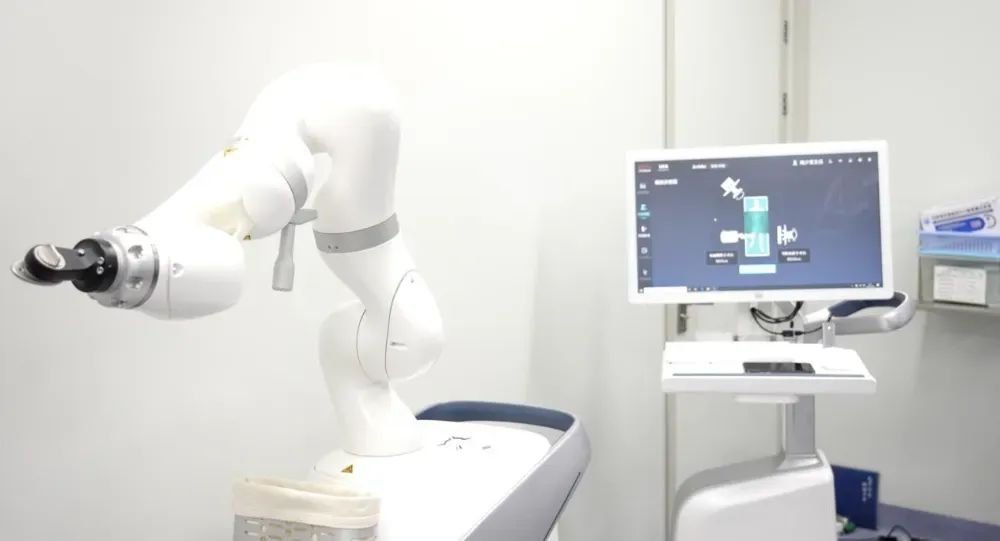
Yuanhua Tech’s KUNWU comprehensive orthopaedic surgical robot has completed its first clinical surgery in an international hospital, marking a step forward in the company’s overseas commercialisation strategy.
The procedure was performed on May 29, 2026 at Santa Casa de Jaú Hospital in Jaú, São Paulo, Brazil. The robot assisted in a left total knee replacement for a 73-year-old female patient, led by orthopaedic surgeon Dr José Roberto Pengo Junior. Postoperative X-ray films showed that the patient’s lower limb alignment was restored as expected.
The milestone addresses a key challenge in orthopaedic robotics: whether systems can move beyond regulatory approval and integrate into real-world hospital workflows across different markets. For public hospitals and emerging healthcare systems, compatibility with local clinical practices, implant preferences and procurement realities is central to adoption.
KUNWU differentiates itself through an open-platform architecture designed to support data integration from multiple implant brands. During the Brazilian case, the system was used with a local prosthesis brand, requiring it to complete preoperative planning, bone cutting execution and intraoperative navigation within a new prosthesis data framework.
This open design is relevant because many mainstream orthopaedic robotic systems are closely bundled with specific prosthesis brands. In markets such as Brazil and Southeast Asia, where local implant brands may offer cost and supply chain advantages, closed systems can limit hospital choice and constrain adoption.
The system uses a three-cart collaborative architecture comprising a main control cart, navigator cart and robotic arm cart. Before surgery, KUNWU performs 3D reconstruction based on CT scans to support quantitative analysis of lower limb alignment and bone cutting requirements. During surgery, its intraoperative navigation system tracks anatomical changes at a refresh rate of 335 Hz, while the robotic arm constrains movement within defined safety boundaries to support sub-millimetre execution precision.
Yuanhua Tech stated that KUNWU has obtained registration clearances in multiple countries and regions, including Brazil, and recently secured EU MDR certification from BSI. Domestically, the system has accumulated more than 6,000 clinical cases across joint, spine and trauma scenarios, with seven major clinical centres established.
As surgical robotics expands beyond high-income markets, systems that can adapt to local implant choices and clinical workflows may have stronger scalability. KUNWU’s international clinical launch highlights how open-architecture robotics could shape the next phase of orthopaedic technology adoption.