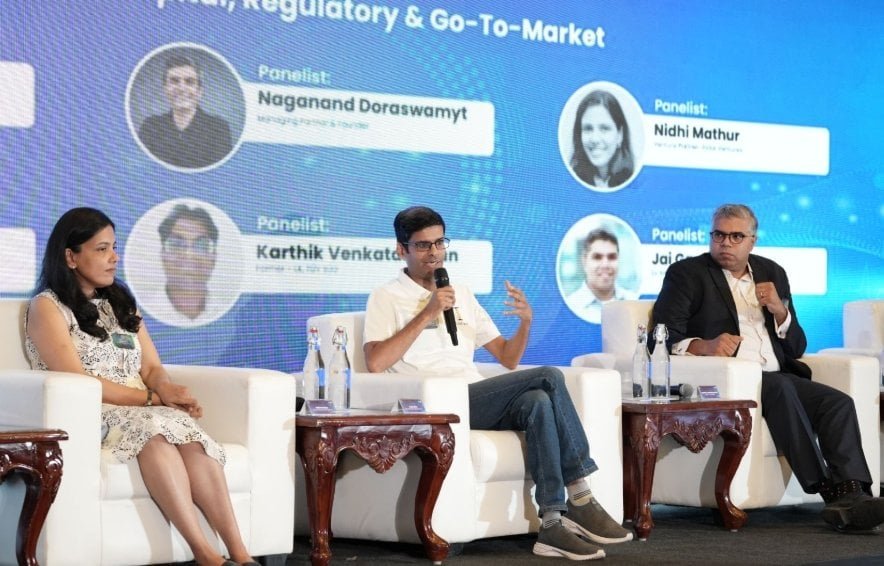
The panel discussion on “Capital, Regulatory & Go-To-Market”, part of the MedTech Scale-up workshop organised by IKP Knowledge Park, evolved into a deeply candid and experience-driven dialogue on what truly determines whether a MedTech startup succeeds or stalls.
The session featured Naganand Doraswamy, Managing Director and Founder of Ideaspring Capital; Nidhi Mathur, Venture Partner at Axilor Ventures; Arjun Rao, General Partner at Speciale Invest; Karthik Venkataraman, regulatory and compliance expert formerly associated with TÜV SÜD and UL; Jai Ganesh, CEO of Dhariki Labs; and Sridhar Ramanathan, Senior Vice President at IKP Knowledge Park and CEO of IKP EDEN.
The session was moderated by Sridhar Ramanathan, who intentionally framed the discussion to move beyond surface-level insights and encouraged panellists to be direct, even critical, in their feedback—reflecting the real-world scrutiny founders face.
At the outset, Naganand Doraswamy of Ideaspring Capital highlighted a foundational disconnect in many early-stage MedTech ventures: the gap between research and productisation. He explained that while India produces strong scientific and academic innovation, founders often approach investors with solutions that are still in the realm of exploration rather than execution. Venture capital, however, requires a certain level of de-risking of the science, not necessarily complete certainty, but enough clarity that the idea can realistically transition into a manufacturable, usable, and sellable product. He emphasised that productisation is not merely about building a prototype, but about demonstrating a clear understanding of engineering feasibility, usability in real-world conditions, cost structures, and eventual pathways to market adoption. Without this, even strong science fails to translate into investable opportunities.
Expanding on what makes an opportunity compelling, Nidhi Mathur from Axilor Ventures introduced the idea of magnitude of impact as a decisive factor. She articulated that healthcare systems are inherently resistant to change due to risk sensitivity, established workflows, and trust in existing solutions. As a result, startups offering incremental improvements—such as slightly better accuracy or marginal cost savings—struggle to gain traction. She explained this through the lens of behavioural economics, where users tend to overvalue what they already use, making it difficult for new entrants to displace incumbents. Therefore, only solutions that are dramatically better (10x improvements) or fundamentally different have a realistic chance of widespread adoption. She also challenged founders to think beyond the initial solution and articulate the downstream impact—how their innovation would reshape clinical practices, reduce systemic inefficiencies, or unlock entirely new capabilities in healthcare delivery.
From the standpoint of deep tech investing, Arjun Rao of Speciale Invest provided a nuanced framework for evaluating such startups. He explained that deep tech ventures are characterised by high entry barriers, often requiring years of specialised expertise and research. This naturally limits competition but also increases execution risk. Investors, therefore, look for a strong alignment between the problem, the founder’s unique insight, and market timing. Timing, in particular, plays a crucial role—many ideas may have existed in academic settings for years but only become commercially viable when enabling technologies (such as AI, advanced sensors, or data infrastructure) mature. However, he cautioned founders against presenting overly ambitious visions too early, particularly “platform” models that attempt to connect multiple stakeholders simultaneously. Instead, he stressed the importance of identifying a clear initial use case or wedge, where the startup can demonstrate tangible value, gain early traction, and then expand incrementally.
On the go-to-market dimension, Jai Ganesh of Dhariki Labs brought a sharp, practitioner-led perspective rooted in real-world commercialisation. He emphasised that many founders mistakenly begin with the technology (“what”) rather than the problem (“why”), leading to solutions that are technically impressive but clinically irrelevant. He urged founders to develop a deep, almost obsessive understanding of the end user—whether patients, doctors, or healthcare providers—and to design solutions that integrate seamlessly into existing workflows. He also cautioned against the tendency to overcomplicate solutions by layering them with buzzwords like AI or robotics, noting that simplicity often drives adoption. A solution that effectively addresses a critical pain point, even if technologically simple, is far more valuable than a complex system that lacks clear utility.
The regulatory perspective, presented by Karthik Venkataraman, formerly associated with TÜV SÜD and UL, demystified a domain that many founders perceive as opaque and restrictive. He emphasised that regulatory bodies are fundamentally aligned to enable safe and effective innovation, not obstructing it. A key takeaway from his insights was the importance of clarity and specificity—founders must clearly define the intended use of their product, the target population, and the clinical context in which it will operate. He also highlighted that regulatory approval is not a one-time milestone but an ongoing process that evolves as the product develops. Startups that proactively build strong documentation, generate credible clinical evidence, and engage with regulatory frameworks early are far better positioned to succeed. Importantly, he noted that regulators are more receptive when founders present well-structured arguments supported by robust data, effectively making the regulator’s decision-making process easier.
The moderator, Sridhar Ramanathan, played a crucial role in synthesising these perspectives and grounding the discussion in real-world scenarios. By introducing hypothetical but realistic startup cases, he enabled the panellists to apply their frameworks in practical contexts. In one such scenario involving a continuous glucose monitoring device, Nidhi Mathur questioned the startup’s differentiation in a market dominated by large incumbents, emphasising the need for a compelling reason for customers to switch. Jai Ganesh probed deeper into whether the startup truly understood its customer segment and whether it was addressing an unmet need or merely offering an incremental improvement. Karthik Venkataraman added nuance by explaining that while limited clinical data might be acceptable in certain contexts, stronger datasets significantly enhance both regulatory confidence and market credibility.
In another scenario involving an AI-based diagnostic tool for diabetic retinopathy, Arjun Rao highlighted the risks of premature scaling, particularly the push for nationwide deployment without sufficient validation across diverse populations. He advocated for a phased approach, starting with controlled pilots in specific regions to refine the product, validate performance, and build credibility before expanding. This approach not only reduces risk but also provides valuable insights that can inform broader rollout strategies.
Collectively, the discussion underscored that success in MedTech is inherently multidisciplinary, requiring alignment across technology, clinical validation, regulatory compliance, and market strategy. A recurring theme throughout the session was the need for focus, clarity, and realism. Founders must resist the temptation to overpromise or overbuild and instead concentrate on solving a well-defined problem exceptionally well. The panel also highlighted that while capital, regulation, and go-to-market are often treated as separate domains, they are deeply interconnected—decisions in one area inevitably influence outcomes in the others.
In conclusion, the session, under the thoughtful moderation of Sridhar Ramanathan, served as a powerful reminder that building a successful MedTech company goes far beyond innovation. It requires disciplined execution, deep customer understanding, strategic navigation of regulatory pathways, and a clear vision for scaling impact. The panel’s candid insights provided founders with a realistic blueprint for navigating the complex journey from idea to impactful healthcare solution.