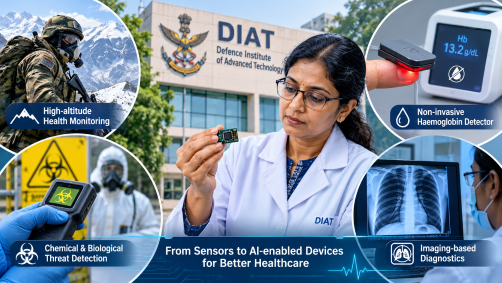
The Defence Institute of Advanced Technology (DIAT) is developing a range of sensor-based medical diagnostic technologies, including a non-invasive haemoglobin detector, high-altitude health monitoring sensors and systems for detecting chemical and biological threats.
Speaking about the institute’s research initiatives, Dr. Sangeeta Kale, Professor and Dean of Research at DIAT, said the institute is working across multiple healthcare and medical diagnostics domains, with a focus on developing technologies that can address critical health challenges in both defence and civilian settings.
One of the key projects involves developing sensors to monitor the health parameters of soldiers deployed at high altitudes. The technology aims to identify health complications associated with hypoxia and oxygen deficiency, which can pose significant risks to personnel operating in high-altitude environments.
In another significant development, DIAT has developed an optical, non-invasive haemoglobin detection device that can measure haemoglobin levels without requiring a blood sample. The technology is particularly relevant for patients with conditions such as thalassaemia, who may have low haemoglobin levels and require frequent monitoring.
According to Kale, the project was initiated approximately six years ago, and the institute has recently transferred the technology to a Pune-based company for further development and potential commercialisation.
DIAT is also developing sensors for detecting hazardous chemical and biological threats, including nerve agents, explosives and propellants. These technologies are intended to identify potentially life-threatening substances that can be dispersed into the atmosphere, posing serious risks to human health.
Another area of research involves medical diagnostics using imaging techniques. During the Covid-19 pandemic, the institute worked on image-based diagnostic approaches to assess the extent of infection through chest and cardiac imaging.
Highlighting the institute’s broader research capabilities, Kale said DIAT works across the complete medical diagnostics development cycle, from sensor development to the creation of AI-enabled diagnostic devices.
These initiatives reflect the growing role of defence research institutions in developing healthcare technologies with applications extending beyond military requirements, particularly in non-invasive diagnostics, remote health monitoring and rapid detection of hazardous biological and chemical agents.