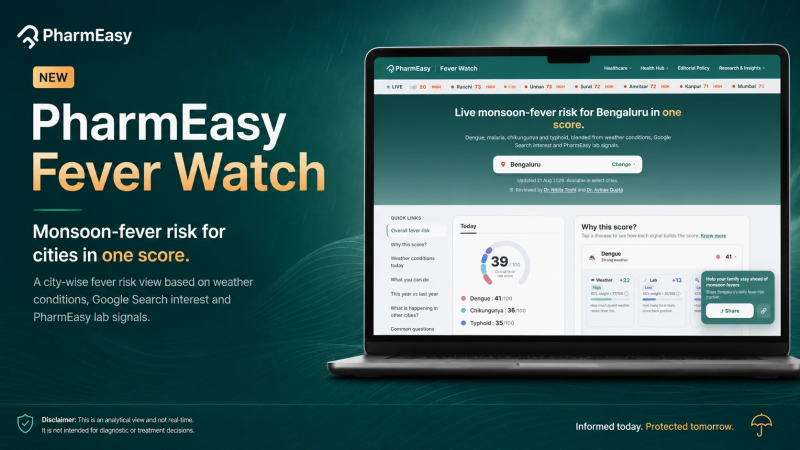
Monsoon fever risk across India has entered the period when it has historically been highest, with PharmEasy’s Fever Watch recording a rise in national risk levels and a sharp increase in the number of cities classified as high risk. The national risk score increased from 47 in the first week of the season to 61 as of 12 August, while the number of cities reporting HIGH risk rose from one in mid-July to 10.
Overall, fever risk is now higher than at the beginning of the season in 186 of the 209 cities tracked by Fever Watch. The increase coincides with stronger rainfall and more favourable mosquito-breeding conditions, with the national weather and breeding signal rising from 48 to 87. Fourteen-day national rainfall also increased from around 35 mm at the start of the season to approximately 133 mm.
Cities including Karimnagar and Ramagundam in Telangana, Chandrapur in Maharashtra and Jaipur in Rajasthan have recorded particularly sharp increases in risk.
However, the latest Fever Watch data highlights that the monsoon fever burden extends beyond mosquito-borne diseases. Typhoid currently has the highest test positivity among the four illnesses tracked by the indicator, at 25.5 per cent, compared with 8.5 per cent for dengue, 1.4 per cent for malaria and 1.8 per cent for chikungunya.
Typhoid is also contributing to the high-risk status in seven of the 10 cities currently classified as HIGH. Unlike dengue, malaria and chikungunya, typhoid is primarily associated with contaminated food and water, making safe drinking water, food hygiene and sanitation particularly important during the monsoon.
PharmEasy noted that some typhoid tests can also produce false-positive results, making clinical evaluation and diagnosis by a doctor important before treatment decisions are taken.
“Every monsoon, fever is often dismissed as ‘viral’ or immediately associated with dengue. But our data shows that the picture is more complex. This season, typhoid is the most-confirmed fever test and is driving seven of the ten cities currently at HIGH risk,” said Gaurav Verma, Chief Business Officer, PharmEasy. “With our ‘You Think It’s Viral?’ campaign and Fever Watch, we want to challenge that assumption and help people look beyond the obvious, using data to understand what is happening in their city and make more informed healthcare decisions.”
Historical Fever Watch trends indicate that overall fever risk generally remains elevated from August through the later monsoon months. PharmEasy also noted that dengue test-positivity during the 2025 season continued to rise through the monsoon, peaking in late October, underscoring the need for continued vigilance as the current season progresses.
Dr Avinav Gupta, Assistant Manager, PharmEasy, said, “Fever can be caused by several different infections, and symptoms alone may not always tell us which one it is. This season, typhoid is showing the highest test positivity among the four fevers tracked by Fever Watch, which is a reminder not to assume that every monsoon fever is viral or mosquito-borne.”
“If a fever persists, testing and medical evaluation can help identify the underlying cause and guide appropriate treatment, rather than relying on guesswork,” he added.