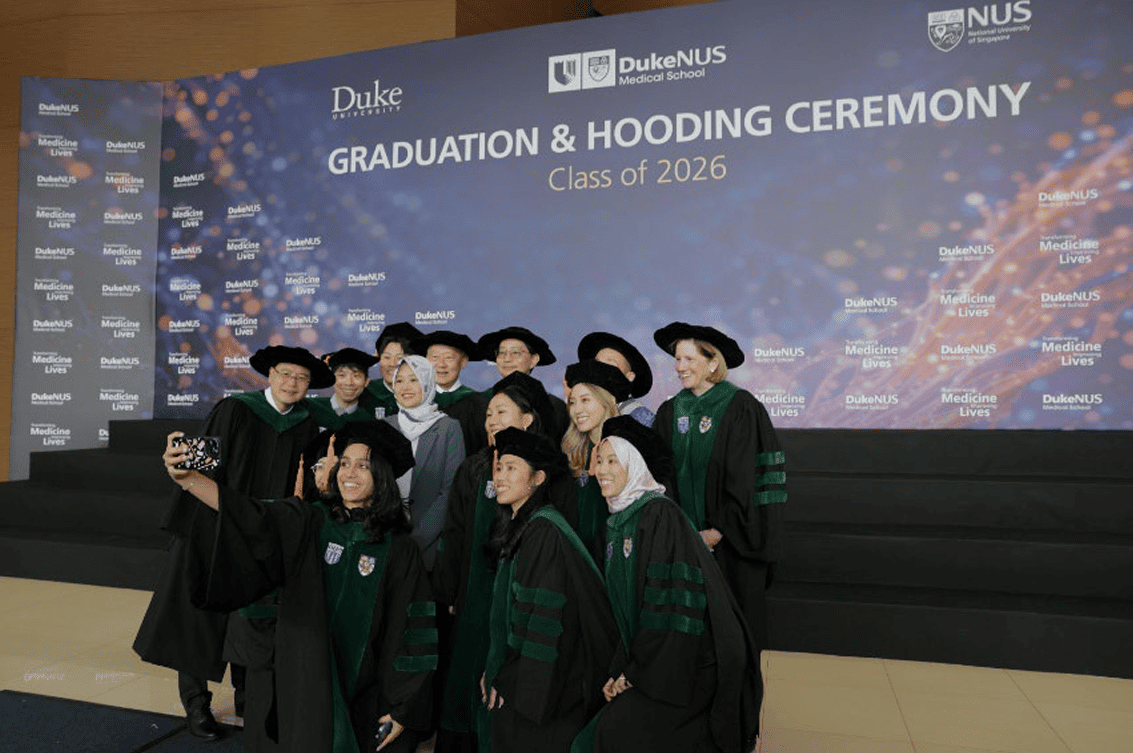
Mdm Rahayu Mahzam with graduates from the Duke-NUS Medical School Class of 2026 and leaders from Duke-NUS, Duke University, NUS and SingHealth
Duke-NUS Medical School has graduated its largest class to date, with 135 graduates crossing the stage at its 2026 commencement ceremony in Singapore.
The Class of 2026 included 72 graduates from the MD programme, six MD-PhD graduates, 38 PhD graduates, and 19 graduates from the Master’s in Patient Safety and Healthcare Quality programme. Among the MD graduands, there was an even split of 39 men and 39 women.
The ceremony was the first graduation led by Dean Professor Patrick Tan. It was attended by Guest of Honour Mdm Rahayu Mahzam, Minister of State for Digital Development and Information and for Health, and featured keynote remarks by Dr Robert Califf, who spoke about the opportunities and changes reshaping medicine, healthcare and biomedical science.
A key highlight of the graduating class was the wide range of academic and professional backgrounds represented. Duke-NUS’ graduate-entry model brought together students from engineering, product development, computer science, multimedia, business, accountancy, linguistics, psychology, history, communications, literature and the sciences.
This diversity reflects the changing needs of healthcare, where future doctors and scientists are expected to work across clinical practice, research, innovation and technology. As healthcare systems become more complex, the ability to approach medicine from different disciplines could be increasingly important in supporting better patient care and biomedical development.
Research also remained a major part of the Duke-NUS training model. MD students devote their third year to research, and the Class of 2026 produced 71 papers across areas such as artificial intelligence in healthcare, predictive clinical tools, biological discovery, diagnostic innovation and population health. These papers included publications in journals such as Cell, The Lancet Microbe, Nature Communications and npj Digital Medicine.
One notable research contribution came from MD-PhD graduate Charles Kevin Dee Tiu, who worked on a rapid test that identified infection-blocking antibodies within hours to support Singapore’s COVID-19 response. The paper, published in Nature Biotechnology, has been cited 1,392 times.
Community service was another focus for the graduating class. Students participated in at least 14 community projects in Singapore and overseas, including school-readiness programmes, overseas medical missions to Nepal and Sri Lanka, chronic disease screening for migrant workers, and initiatives supporting children with cancer and women’s health.
Dr Jiang Qianfeng, graduating speaker of the MD Class of 2026, said the class’s service experiences showed that medicine does not start and end within hospital walls. He highlighted the importance of serving diverse communities, including rural outreach programmes, migrant workers, children with brain tumours, community health groups and women’s health initiatives.
Among the student-led initiatives was Project WISE, or Women’s Integrated Screening & Education. The programme provides blood pressure and body mass index screenings, together with education on mental health and breast cancer awareness. It is organised by the Women in Medicine student interest group and supported by the Association of Women Doctors Singapore.
For Singapore’s healthcare and medical sectors, the Class of 2026 reflects a growing emphasis on training clinicians and researchers who can work across disciplines. With graduates contributing to areas such as AI in healthcare, diagnostic innovation, chronic disease research, patient safety and community health, Duke-NUS continues to support the development of a healthcare workforce that is both clinically grounded and innovation-ready.
As healthcare continues to evolve, the latest Duke-NUS graduating class highlights the importance of combining medical education with research, technology, service and cross-disciplinary thinking. This could be crucial in preparing future healthcare professionals to respond to changing patient needs, scientific advances and wider system challenges.