Wearable technology is rapidly evolving from a consumer wellness tool into an increasingly valuable source of continuous health data, offering clinicians new opportunities for early risk detection, personalised monitoring and preventive care. From heart-rate and rhythm monitoring to sleep, blood oxygen, activity and glucose data, wearables are generating insights that can complement traditional clinical assessments. However, translating this growing stream of patient-generated data into meaningful clinical action requires robust validation, contextual interpretation and seamless integration into healthcare workflows.
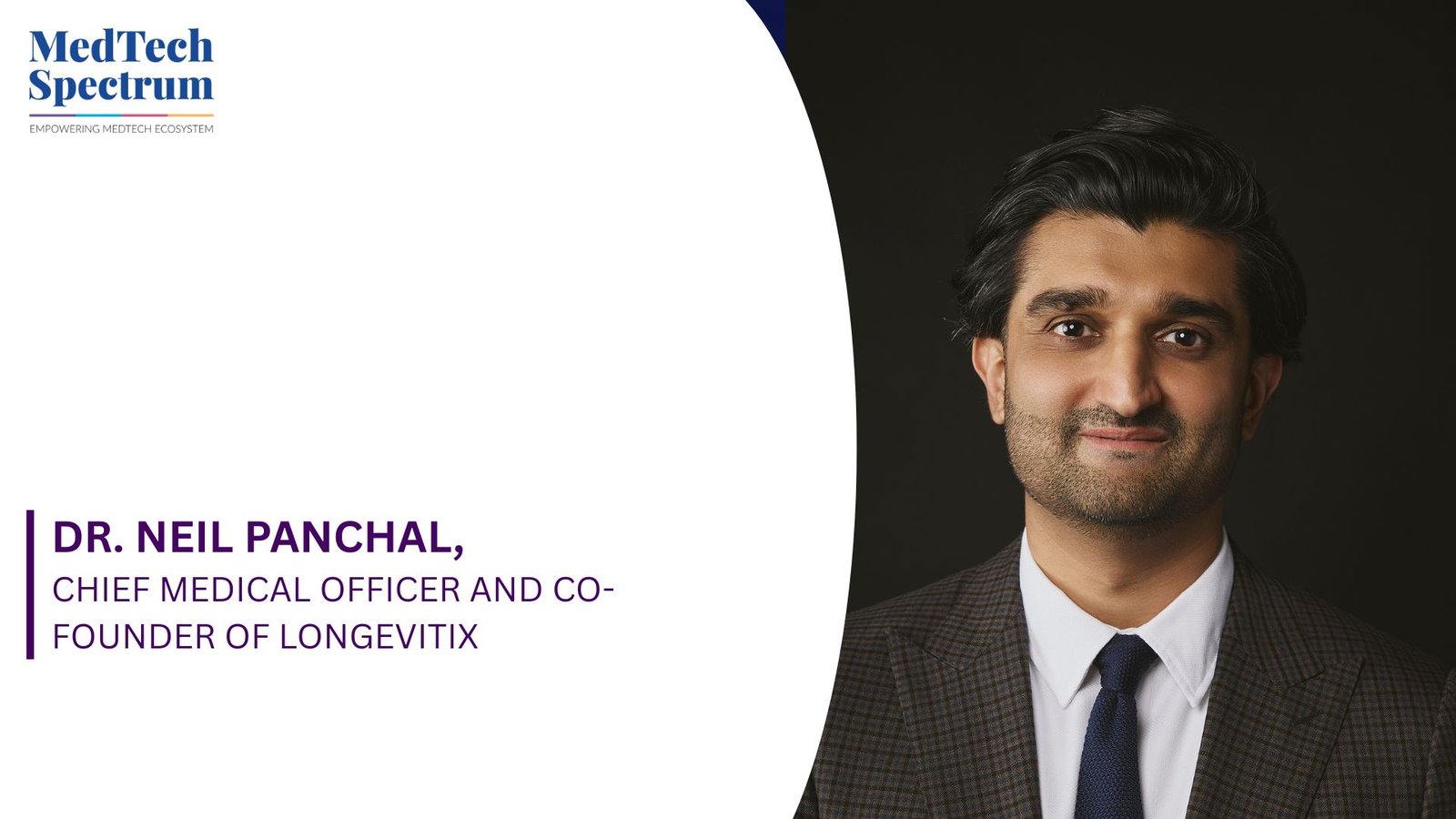
In this interview, Dr. Neil Panchal, Chief Medical Officer and Co-founder of Longevitix, discusses the clinical value and limitations of wearable-generated health metrics, the reliability of consumer devices, and the role of AI in converting continuous data into personalised and proactive health insights. He also explores how wearables could support earlier detection of atrial fibrillation, sleep apnoea, metabolic dysfunction and other chronic health risks, while highlighting the importance of clinician oversight, interoperability, regulatory standards and patient privacy in shaping the next phase of digital health.
As wearables go mainstream, which metrics and capabilities currently offer the greatest clinical value, and where should consumers be cautious about overinterpreting the data?
The metrics that carry real clinical signal are the ones that have earned it through prospective validation. Photoplethysmography-based rhythm detection is the clearest win. For example, the Apple Heart Study demonstrated an 84 per cent positive predictive value against simultaneous ECG patch monitoring, and the Fitbit Heart Study replicated that with a 98 per cent PPV using a more restrictive algorithm. Resting heart rate and step count are unglamorous but powerful; Michael Snyder's group at Stanford used exactly those two signals to detect COVID-19 at or prior to symptom onset in 80 per cent of cases in their real-time monitoring cohort. That is a genuinely remarkable result and worth internalizing. Using only two simple continuous metrics, monitored longitudinally, it is possible to outperform symptom self-report as an early warning system.
Where interpretation gets nuanced: sleep-stage percentages, single-day HRV readings, and composite readiness or recovery scores. Dr. David Lipman — an Australian-trained physician and exercise physiologist who writes at Health Performance Nexus — has made the useful point that clinicians and consumers get more mileage from two-phase sleep measures (sleep versus wake) than from four-stage classification, and that composite scores can hide more than they reveal when their inputs are noisy. That framing is constructive rather than dismissive: the underlying signals are useful, they just reward trend-reading over point-in-time interpretation.
Practical use: track the trend, not the number. A three-week drift in resting heart rate or a sustained drop in HRV means something a physician should hear about; a single anomalous night usually does not.
How reliable are the measurements generated by consumer wearables heart rate, sleep, blood oxygen, activity and what factors influence accuracy and clinical usefulness?
Consumer wearable accuracy has come a long way, and the peer-reviewed picture is genuinely encouraging in most metrics.
Heart rate at rest: reliable on validated devices. Duke's head-to-head validation study put the Apple Watch well within a mean absolute error range that supports clinical trend interpretation. Accuracy degrades predictably in specific conditions: motion, cold environments, tattoos over the sensor, and darker skin pigmentation, because green LEDs are absorbed more by melanin. The 2026 systematic review of Apple Watch validation across 82 studies and more than 430,000 participants confirmed that it is reliable in most conditions, with known limitations worth adjusting for.
Sleep: two-stage classification is very good. The 2024 Chinoy validation study found strong sensitivty data for sleep-versus-wake detection across the Oura Ring Gen 3, Fitbit Sense 2, and Apple Watch Series 8 against polysomnography. Four-stage classification is where accuracy is still maturing depending on device and stage, but even the gold standard of polysomnography only achieves about 83% inter-rater agreement between two human scorers. Consumer devices are closing on the human ceiling faster than most people appreciate.
SpO2: performing well within its validated envelope, and getting better. The FDA's January 2025 draft guidance now requires an important upgrade that will lift accuracy and minimize bias across populations over the next device generation.
Activity: step count is directionally reliable and consistently improved over the last decade. Calorie estimates are best treated as relative rather than absolute.
Practical use: match the metric to the decision. Trend-based interpretation of resting HR, HRV, sleep duration, and step count is clinically useful now. For calorie counts and detailed sleep architecture, use them as motivational context, not as diagnostic input.
What is needed to bridge the gap between consumer wearable data and clinically actionable insights, and how can physicians effectively integrate this information into patient care?
This is the most exciting frontier in the space, and the trajectory is favorable.
The 2026 AMA International Physician Survey on Consumer Wearables surveyed 2,000+ physicians across the United States, Canada, France, Germany, Spain, and the United Kingdom and found that 97 per cent of physicians already review wearable data in some capacity, and roughly 30 per cent of U.S. physicians take a clinical action at least weekly on the strength of it. That is a remarkable adoption curve for a data source that is barely a decade into clinical use. The bottleneck is not physician interest; it is infrastructure. Fewer than 6 per cent of physicians have wearable data integrated into their clinical workflow, and closing that gap is where the next several years of value will be unlocked.
Three ingredients close it. First, ingestion — FHIR-based standards for consumer wearable data are being implemented across major EHRs, and the pace is accelerating. Second, interpretation — physicians benefit enormously from an intermediate layer that summarizes weeks of continuous data into a small number of clinically meaningful signals, freeing appointment time for judgment rather than data-mining. Third, contextualization against the rest of the biomarker panel — a resting heart rate that has climbed from 58 to 68 over four weeks means something specific when the patient's ApoB is 130 and they've started tirzepatide; in isolation it means little.
There are times when I believe wearable technology can create more harm than benefit, thus, patient selection is a critical variable. Widespread wearable use in low-risk populations generates false-positive burden and health anxiety. The response is not to remove wearables from clinical life since patients already wear them, already show up with the data, and already request an interpretation. The response is to build the triage and contextualization layer that converts a raw device notification into a properly weighted clinical signal.
This is exactly the design brief for a physician-facing clinical decision support layer. At Longevitix, we've built precisely this kind of contextualization. The platform surfaces wearable trends against the patient's biomarker trajectory so the physician sees signal rather than the raw data stream. The physician remains the attending. The data is the resident on the wards, doing the observation work. The physician still writes the orders, but with a much better handoff.
Practical use: physicians should ask patients directly about wearable data before/at each visit and focus on trend changes over the prior 4 to 12 weeks rather than single readings. Consumers should share device data proactively with their clinician, especially any sustained trend shift.
AI is increasingly used to analyze large volumes of wearable data. How can AI transform raw, continuous data into personalized, proactive recommendations while ensuring clinical accuracy?
This is the fastest-moving and most promising area in the entire space.
The Stanford SleepFM model, published in Nature Medicine in early 2026, trained a foundation model on 585,000 hours of polysomnography from approximately 65,000 participants and demonstrated accurate prediction of 130 conditions from a single night of sleep including all-cause mortality, dementia, myocardial infarction, and heart failure. That result validates a thesis physicians have suspected for years: sleep physiology contains a dense and readable signal about future disease risk, and machine learning can extract it at scale.
The productive frame going forward is personalized-baseline anomaly detection rather than population-threshold alerts. Michael Snyder's group at Stanford has been building this approach for a decade. Foundation models trained to learn each individual's baseline and flag meaningful deviations are technically achievable now, representing a genuine step change in preventive medicine.
The responsible-use scope is well understood: AI on wearable data functions as clinician decision support, not autonomous prescribing. It surfaces the signal, contextualizes it against the patient's history, and escalates to the physician.
Practical use: patients should look for wearable platforms that emphasize personal baseline trends over generic population comparisons. Physicians should prioritize AI-derived alerts that come with the underlying data trend visible, so the clinical judgment can be exercised in context.
Can wearables play a meaningful role in early risk detection and prevention of chronic disease? Which areas of preventive healthcare are likely to benefit most?
Yes — and the highest-yield use cases are already visible in the peer-reviewed data.
Atrial fibrillation. The best-validated use case. The Apple Heart Study and Fitbit Heart Study both demonstrated that PPG-based irregular rhythm detection catches paroxysmal AF that would otherwise be missed, particularly in older, higher-risk populations. This has real potential to prevent strokes — arguably the single most valuable thing a wristwatch can do. Deployment works best when device screening is paired with clinical judgment about pretest probability, so results are interpreted in the right risk context.
Sleep apnea. A high-yield opportunity. Consumer devices are increasingly good at flagging overnight SpO2 and respiratory patterns that warrant formal sleep-study referral. OSA is dramatically underdiagnosed, and it drives cardiovascular, metabolic, and cognitive risk. The wearable doesn't make the diagnosis; however, it gets the patient into the PSG chair, which is exactly where a wearable can add the most value.
Metabolic health. Continuous glucose monitoring is one of the most exciting frontiers in preventive medicine. The use case in diabetic adults is obvious. However, even in non-diabetic adults, CGMs are surfacing postprandial excursions, insulin resistance patterns, and dawn phenomenon in ways that inform highly personalized dietary and lifestyle guidance. The interpretation is best done with physician support to translate glucose curves into actionable metabolic strategy.
Presymptomatic infection detection. Stanford's group demonstrated 80% detection of COVID-19 at or prior to symptom onset using resting heart rate and step-count changes. Practical high-value cases include immunocompromised patients, oncology patients on active treatment, and elderly patients where early infection detection materially changes outcomes.
Cardiovascular longevity. Continuous HR, HRV, and activity data give physicians a fitness and autonomic-recovery signal that used to require in-lab testing to approximate.
Practical use: patients should choose wearables with FDA-cleared or validated features for the specific outcomes they care about, and share the data with their physician. Physicians should treat wearable data as an early-warning system that expands their monitoring window from twice-yearly visits to continuous.
Looking ahead, how do you see wearable technology evolving over the next five years, and what will be required from clinicians, technology companies, and regulators to deliver clinical value while protecting privacy and trust?
The next five years look genuinely promising, with several converging trends.
Ambient sensing expands beyond the wrist. Dr. Hon Pak at Samsung has been public about this trajectory, with examples such as optical measurement of advanced glycation end products via wrist fluorescence, skin-based carotenoid and antioxidant indices, and passive data aggregation from home devices and vehicles. Physiology gets contextualized against the exposome, and the data volume moves from noise to signal.
Foundation models trained specifically on consumer wearable data. SleepFM validated the architecture on polysomnography. The equivalent model trained on longitudinal wrist and ring data, with personalized baselines and anomaly detection, is technically feasible now and will likely be published within the five-year window.
Regulatory maturation. The FDA's January 2025 draft guidance on pulse oximeter validation across skin pigmentations is the template. Expect similar guidance for PPG-based cardiovascular metrics and AI-derived risk scores, which will lift accuracy and trust across the field.
Reimbursement. CPT pathways for structured wearable-data review will emerge over the next several years. The AMA survey identified reimbursement as one of the strongest predictors of physician adoption, and the demand signal is now clear.
What each stakeholder brings:
Clinicians build fluency in what wearables measure well and where they need contextualization, so patient-generated data can be triaged intelligently.
Technology companies invest in transparent validation across diverse populations, publish failure modes alongside success rates, implement FHIR-compliant data portability, and partner with the clinician community rather than bypass it.
Regulators clarify the wellness-versus-medical-device distinction, modernize privacy frameworks for continuous physiological data, and build reimbursement pathways that reflect the value physicians already generate from wearable data review.
Practical use: patients should keep wearing their devices, share the data with their physician, and treat the tools as part of a partnership rather than a substitute for one. Physicians should invest a small amount of time developing personal fluency in the two or three metrics most relevant to their patient population — resting HR, HRV, and sleep duration are the highest-yield starting points.