As medical device companies navigate increasingly complex markets shaped by physician movement, hospital consolidation, expanding ambulatory surgery centres (ASCs), evolving reimbursement policies and shifting sites of care, artificial intelligence is emerging as a strategic tool for commercial teams. AcuityMD, an AI-powered commercial intelligence platform for MedTech, has now surpassed 500 medical device customers, including 16 of the top 20 MedTech companies, highlighting the growing demand for AI-driven insights that can translate fragmented healthcare data into actionable commercial opportunities.
From identifying high-potential physicians and analysing referral networks to preparing for customer meetings and developing targeted call plans, AI is increasingly moving beyond routine productivity tasks to influence how MedTech sales teams prioritise opportunities and allocate their time. AcuityMD’s launch of AcuityAI further advances this shift by allowing users to interact with complex market data through natural-language queries and receive grounded, cited insights in seconds.
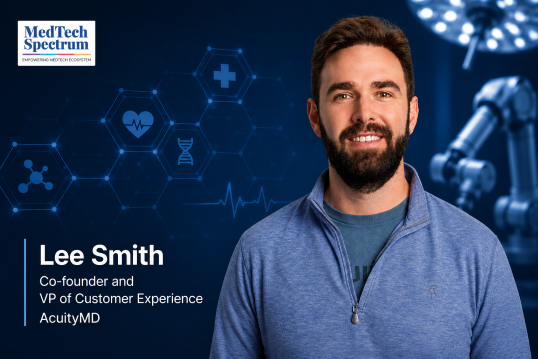
In this interview with Lee Smith, Co-founder and VP of Customer Experience at AcuityMD, we explore the factors driving AI adoption across the medical device industry, how the company’s proprietary MedTech ontology connects fragmented healthcare and commercial data, and how generative AI is changing sales workflows and decision-making. Smith also discusses measuring AI’s impact on productivity and decision quality, ensuring trustworthy AI recommendations, and AcuityMD’s vision for the next phase of AI-native and autonomous commercial workflows in MedTech.
AcuityMD has now surpassed 500 medical device customers, including 16 of the top 20 MedTech companies. What are the key factors driving the growing adoption of AI-powered commercial intelligence across the medical device industry?
The biggest factor is commercial complexity, a mess so unwieldy that traditional approaches are not keeping up. MedTech organizations are struggling to manage physician movement, evolving health system relationships, expanding sites of care, changing reimbursement policies, and increasingly competitive markets. All of these issues and more are in a constant state of change, and they directly impact where commercial opportunities exist.
At the same time, AI has matured far beyond just a productivity tool into something that teams can use to make better commercial decisions faster. As an example, AI now can take all the fragmented data that commercial teams use across claims, CRM systems, territories, contracts, and more and turn it into usable intelligence that helps MedTech reps close more deals.
MedTech commercial teams must navigate physician movement, hospital consolidation, the growth of ASCs, changing reimbursement policies and shifting sites of care. How does AcuityMD’s proprietary MedTech ontology help companies turn these fragmented market dynamics into actionable commercial insights?
The biggest challenge is not that the data doesn't exist; rather, it's that the data lives in dozens of disconnected systems and doesn't naturally relate to one another.
AcuityMD’s proprietary MedTech ontology is the connective tissue between all the data sources. It maps the relationships between physicians, facilities, health systems, products, procedures, contracts, territories, reimbursement, and other commercial factors into a common framework. This connective tissue empowers organizations to better understand not just individual data points, but how changes in one part of the healthcare ecosystem affect commercial opportunities elsewhere.
Once those relationships are connected, AI can reason over them. Instead of asking a sales rep to manually piece together information from multiple systems, AcuityAI can quickly identify meaningful changes in a territory, surface new opportunities, and recommend the next best actions.
With the launch of AcuityAI, users can interact with market data using natural language. What are some of the most valuable use cases you are seeing among customers, and how is generative AI changing the way MedTech sales and commercial teams make decisions?
Today’s biggest use cases fall into a few categories. Complex targeting is one of the biggest – i.e., reps request AI to "find targets nearby with an upward trend in one procedure but a downward trend in another, within a certain number of years out of residency, operating out of an ASC." These kinds of queries used to take hours of manual cross-referencing and now take seconds with AcuityAI.
We're also seeing heavy use of AcuityAI in referral network analysis, call and meeting prep, and account research where reps aggregate a comprehensive view of a provider's network, referral patterns, and recent case history before a conversation instead of assembling that picture from memory or scattered spreadsheets.
What's changing is the nature of the questions teams can ask as well as how simple it is now to ask them. Instead of "who are my top accounts," reps and sales leaders can ask nuanced, multi-variable questions and get grounded, cited answers back immediately. This used to be a process where teams would be reviewing multiple dashboards to find answers. One customer told us a targeting list that used to take about 12 hours of manual work now takes minutes!
The broader shift, though, is from tactical to strategic use of AI. As we confirmed in our recent survey – AI Adoption in MedTech Sales: 2026 Industry Benchmarks and Trends – most AI adoption has been tactical, such as drafting emails (78 per cent), organizing tasks (69 per cent), and generating meeting summaries (67 per cent). That's useful, but it's the tip of the iceberg of AI's potential. The real value of generative AI in commercial MedTech is using it to surface insights reps would not have otherwise found (i.e., where the opportunities are, which physicians to prioritize, how a market is shifting, etc.) during moments that used to be dead time, like when a case gets canceled last-minute. That's the difference between AI that saves you a few minutes and AI that changes how a commercial team allocates its time and makes decisions.
AcuityAI has helped customers generate thousands of call plans and reportedly saved sales representatives around 180 hours of preparation time annually. How do you measure the impact of AI on sales productivity and the quality of commercial decision-making?
We measure it by looking at two things together: 1) how long a task takes manually, and 2) the level of complexity that AcuityAI can afford commercial teams.
Take call planning as an example. Pulling together procedure volumes, referral patterns, competitive context, and talking points for a single meeting manually across a CRM system, AcuityMD, and outside research realistically takes about 30 minutes. Assuming 8 to 10 meetings a week, that equates to between 3-5 hours of prep time each week. AcuityAI compresses that same depth of preparation down to mere minutes. We see the same pattern in opportunity prioritization, where a complex, multi-variable targeting question that used to take 45 minutes to answer manually now takes about 2 minutes, and in re-planning after a last-minute cancellation, where reps go from a 15-to-20-minute scramble to a data-driven answer immediately after they input their prompt.
But time saved is only half the story, and it's not always the right way to think about it. Not every rep was doing that deep level of manual work to begin with – many had made a rational trade-off to spend their time in front of customers rather than behind a screen building a target list or a call plan. For those reps, AI's impact shows up as quality, not time: they're now getting the depth of a 45-minute analysis in the same amount of time they were already spending, so the decision itself gets better even though the clock doesn't change. We’re lowering the barrier to entry for sales teams where they can take advantage of insights they previously would never have even found.
Exciting evidence of AI at work was reported in our survey, too. We found that MedTech sales reps who use AI at work are three times more likely to meet or exceed quota than those who do not. Conversely, reps who did not meet quota were almost twice as likely to have never used AI professionally.
Ultimately, AI impact must be measured from both angles: the hours returned for reps who were already doing the work manually (time), and the improvement in decision quality for reps who were not (quality).
As AI adoption accelerates in healthcare and MedTech, data accuracy, privacy and trust are becoming increasingly important. How does AcuityMD ensure that AI-generated recommendations are grounded in reliable, current and relevant healthcare market data?
At AcuityMD, we think about this in two parts: getting the data right, and getting AI's relationship to that data right.
On the data side, AcuityAI sits on top of our proprietary MedTech ontology — a model of how devices, HCPs, sites of care, and procedures relate to each other, built from real-world claims and commercial data that we keep current. That distinction matters more than people realize. Raw claims data on its own doesn't know how a device, a physician, and a site of care connect; without that structure, an AI system is left to guess at those relationships, and guessing is where hallucination creeps in.
And that is the second part: grounding. We built AcuityAI so that every recommendation is routed through and checked against that ontology, rather than letting a language model freelance connections it cannot verify. We also run ongoing quality monitoring on outputs. Testing isn't a one-time step before launch, but continuous, because an AI system that's confidently wrong is more dangerous than one that says, "I don't know." Where we can, we design outputs to show their work (the data and methodology behind a recommendation) so users can validate an answer rather than just trust it blindly.
Looking ahead, what are the next areas of AI innovation AcuityMD plans to focus on, and how do you see AI reshaping the commercial strategy and growth functions of medical device companies over the next few years?
AcuityMD thinks about AI adoption as happening in waves. Most MedTech companies are still in the early wave, using generative AI assistants that help with things like drafting copy and summarizing meeting notes. The next wave is AI-native workflows, where AI doesn't just answer a question but autonomously completes multi-step work end-to-end. This looks like building a target list or assembling a call plan or running a market analysis in a new geography.
Longer-term, AI will become more proactive and custom to each user's experience. This is where we're focused today – providing the right context and customization, which is the foundation for better AI. In the future, a rep won't have to submit a prompt; AI agents will have already anticipated and executed the work based on what they already know.