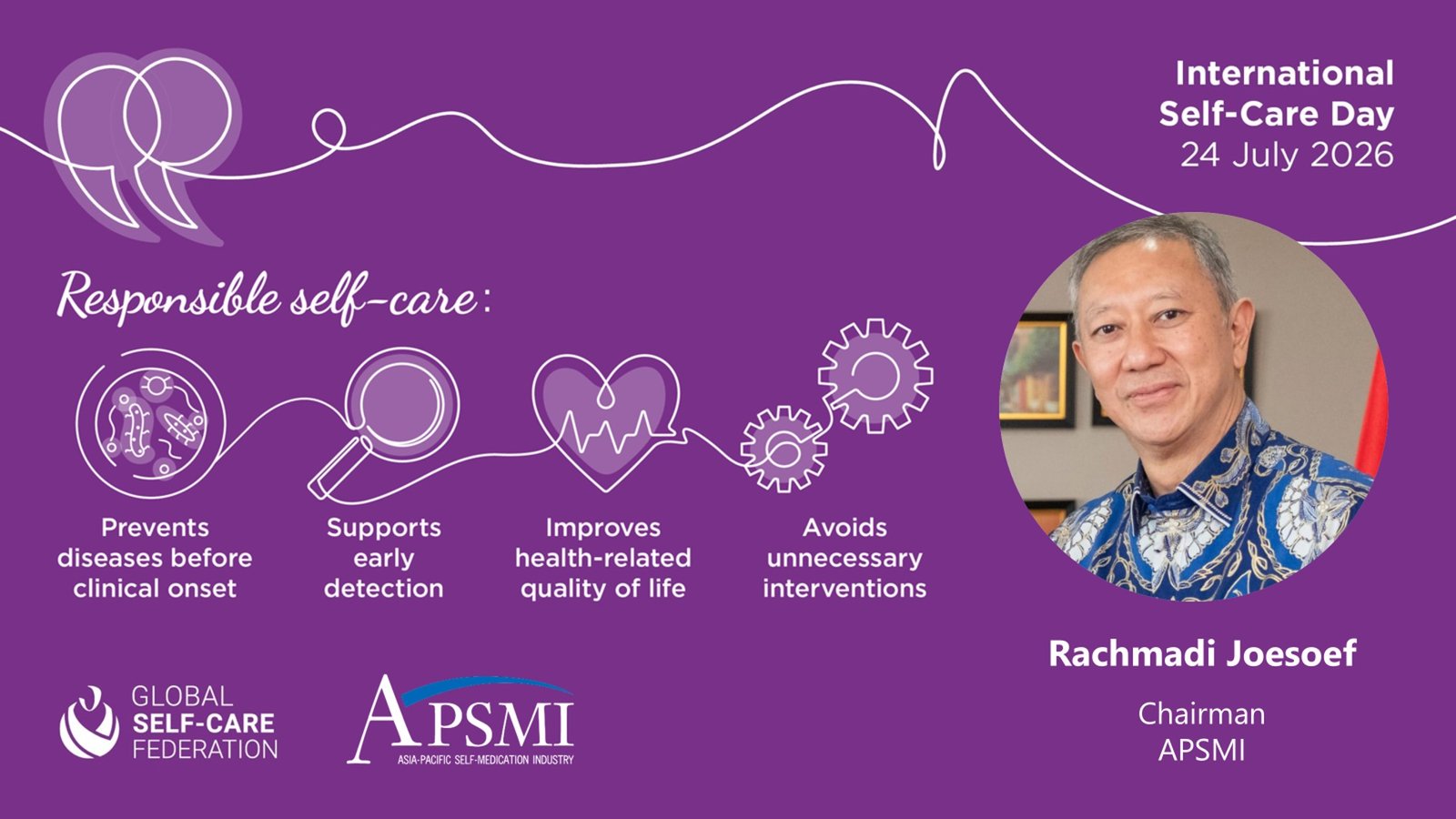
As healthcare systems across many countries in the Asia-Pacific Region continue to face growing challenges, strengthening health literacy has become increasingly important in enabling individuals to make informed decisions about their health. In celebration of International Self-Care Day, APSMI (the Asia-Pacific Self-Medication Industry) highlights the importance of public education, responsible self-medication, and multi-sectoral collaboration as key pillars for strengthening healthcare systems across the Asia-Pacific region.
Self-care is defined as the ability of individuals, families, and communities to promote health, prevent disease, maintain well-being, and manage health conditions, with or without the support of healthcare professionals. When supported by adequate health literacy, self-care enables individuals to appropriately manage minor health conditions as a first line of care while recognising when professional medical consultation is necessary. The World Health Organization recognizes self-care interventions as part of how the world reaches health for all and advances universal health coverage, the goal of everyone accessing care without financial hardship.
According to Rachmadi Joesoef, Chairman of the Asia-Pacific Self-Medication Industry (APSMI), "Growing evidence demonstrates that responsible self-care delivers significant benefits not only for individuals but also for healthcare systems and economies. According to the Socio-Economic Research 2026 report by the Global Self-Care Federation (GSCF), responsible self-care:
Contributes approximately $144 billion in annual savings to global healthcare systems,
Saves around 2.2 billion physician hours
Generates an additional 43.6 billion productive days,
and improves overall quality of life.
It is further estimated that with policies supporting improved health literacy, access to quality-assured over-the-counter medicines, and enabling regulatory frameworks, the social and economic benefits of self-care could increase as much as 50 per cent by 2040."
According to Greg Perry, Director-General, Global Self Care Federation (GSCF), "When fully integrated, self-care delivers a profound return on investment: it empowers individuals, supports communities, and stands as the 'best buy' for financially strained healthcare systems globally,”