
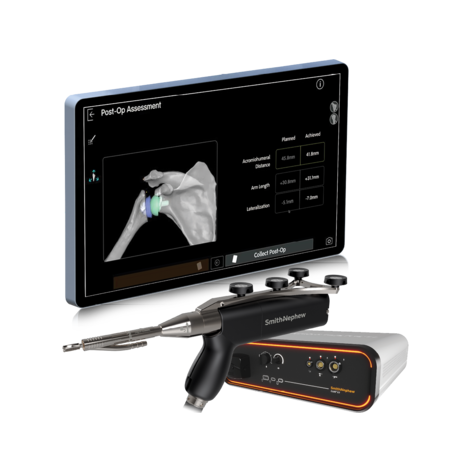
Smith+Nephew has completed the first clinical cases using its next-generation CORI XT Handheld Robotics Platform, marking a clinical introduction milestone for its latest orthopaedic robotics technology.
The platform is designed to support robotic-assisted procedures across partial to revision knee arthroplasty, shoulder arthroplasty and future hip applications, with a compact footprint suited for both hospitals and ambulatory surgery centres. The development addresses a key adoption challenge in surgical robotics: delivering accuracy and planning support without introducing excessive operating room complexity or infrastructure burden.
The first CORI XT shoulder arthroplasty cases were performed at Duke Health by a surgical team led by Dr Christopher Klifto, using CORI SHOULDER Handheld Robotic Arthroplasty with Smith+Nephew’s AETOS Shoulder System. The platform supports handheld robotic execution of both the humerus and glenoid across anatomic and reverse shoulder procedures.
Additional shoulder cases were completed in an ambulatory surgery centre setting by Dr Bertrand Kaper at North Valley Surgery Center in Scottsdale, Arizona. This is relevant as more orthopaedic procedures shift toward outpatient and ASC environments, where workflow efficiency, mobility and smaller equipment footprints are important procurement considerations.
The first knee replacement procedures using CORI XT were completed at NYU Langone Health by Dr Ran Schwarzkopf. These cases mark the platform’s first clinical use in knee arthroplasty and support Smith+Nephew’s broader rollout strategy across joint reconstruction indications.
CORI XT is positioned around Smith+Nephew’s “Skill Amplified” robotics approach, which aims to enhance surgical accuracy while preserving surgeon control, tactile feedback and intraoperative decision-making. The system also integrates with CORIOGRAPH Pre-Operative Planning and Modeling Services to support patient-specific planning and intraoperative execution.
For healthcare providers, depending on surgeon training, case volume, implant ecosystem fit, hospital and ASC workflow integration, there is evidence that handheld robotics can improve consistency without compromising procedural efficiency. The hip indication remains under development, meaning commercial impact will depend on phased expansion across approved indications.
The milestone reflects the continued evolution of orthopaedic robotics from large capital systems toward more mobile, workflow-compatible platforms. As hospitals and ASCs seek technologies that combine precision with operational practicality, handheld robotics may play a larger role in expanding access to robotic-assisted joint replacement.