Artificial intelligence is reshaping diagnostics across healthcare, and its impact is now extending beyond human medicine into veterinary care. By combining advanced metabolomics with machine learning, researchers are unlocking new ways to detect disease earlier, improve diagnostic accuracy and shift healthcare from reactive treatment to proactive prevention. This emerging approach has the potential to transform how veterinarians screen, monitor and manage a wide range of conditions using a single blood sample.
At the forefront of this innovation is LatusPet, whose proprietary SINO platform analyses hundreds of metabolites simultaneously to identify complex biochemical patterns associated with disease. Rather than relying on a handful of conventional biomarkers, the platform uses AI to interpret the body's metabolic network as an interconnected system, enabling the detection of subtle physiological changes that may otherwise go unnoticed.
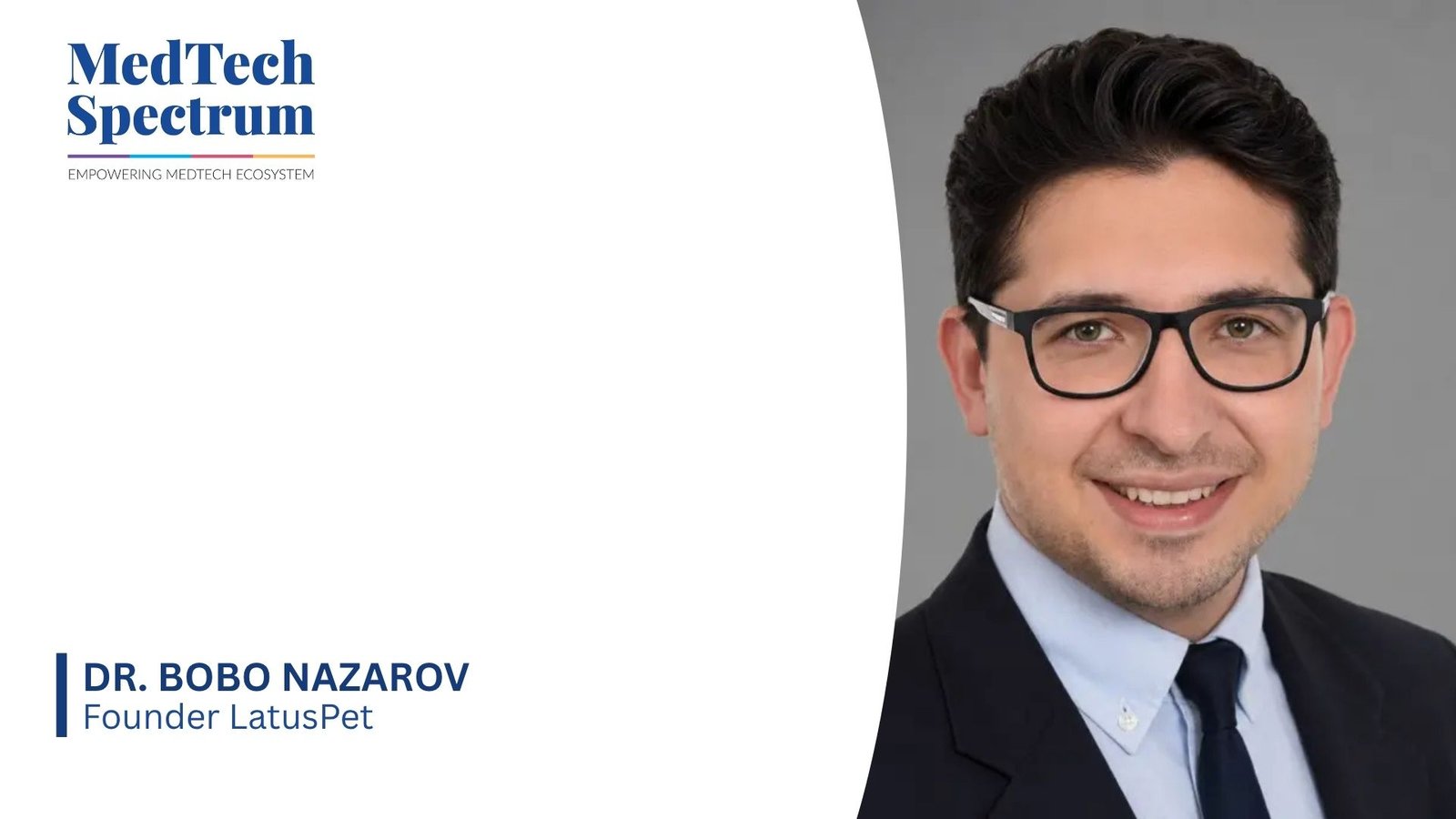
In this exclusive interview with MedTech Spectrum, Dr Bobo Nazarov, Founder of LatusPet, discusses the science behind integrating metabolomics with machine learning, the importance of validating AI diagnostics in real-world clinical settings, and how multi-disease screening could redefine preventive veterinary care. He also shares insights into the challenges of bringing AI-driven diagnostics into everyday practice, the platform's potential for longitudinal treatment monitoring, and his long-term vision for advancing companion animal health. Looking ahead, Dr Nazarov explores how the convergence of AI, metabolomics and the One Health approach could foster closer collaboration between veterinary and human medicine, opening new possibilities for precision diagnostics across species.
Your study demonstrates that the SINO platform can detect multiple diseases from a single blood sample with over 90 per cent diagnostic accuracy. Could you explain the science behind combining NMR-based metabolomics with machine learning, and how this approach differs from conventional veterinary diagnostic methods?
The science behind combining metabolomics with machine learning, and how it differs from conventional methods. My own background is in systems biology, which I studied for my PhD at Oxford, and that is really the lens behind the platform: the body is a system, and its metabolites are interconnected through biochemical pathways, so no single metabolite exists in isolation.
A conventional blood analysis reports perhaps a dozen metabolites (for example, one of the more familiar metabolites is cholesterol) each looked at largely on its own, and it does that job well. SINO is built for a different purpose. It reads hundreds of metabolites from a single blood sample at once, and our proprietary machine learning integrates all of them into a single signature of disease.
The best way to picture it is a constellation. A single star shifting position tells you little on its own, because there is nothing to read it against. But because these metabolites are part of a connected system, when one shifts it influences the others around it, and the whole pattern moves in a characteristic way. It is that change in the overall shape that we recognise, which means even subtle shifts become meaningful, and far more powerful than reading a few metabolites in isolation.
One of the unique aspects of the study was testing the platform against a realistic mix of healthy and diseased animals rather than healthy controls alone. Why is this approach clinically significant, and how does it improve confidence in real-world veterinary applications?
Most diagnostic studies separate one disease from healthy animals alone. That inflates apparent performance, because the model may simply be learning to recognise health rather than the disease itself. It also does not reflect the clinic, where a vet is rarely asking whether an animal is unwell, but what is wrong.
In our study, each condition was separated from a realistic mix of other diseases and healthy dogs together. That is a harder and more honest test, and it is much closer to real-world practice, which is why it gives far greater confidence that the result should hold up in a working clinic rather than only on paper.
The ability to screen for multiple conditions simultaneously represents a major shift in veterinary diagnostics. How do you see multi-disease screening transforming preventive healthcare, early intervention, and routine wellness programmes for companion animals?
This is where the platform is designed to change the model of care. Because SINO reads a broad chemical picture from a single sample, one routine blood draw at a wellness visit can give a wide read on a pet's health, rather than testing for one condition at a time.
Because metabolomics is sensitive to small, coordinated shifts across many signals, it is well suited to catching physiological disturbances early, potentially before clinical signs appear. That is the shift from reactive to proactive care: instead of waiting for symptoms and then investigating, a vet can screen broadly and act sooner. Over time, as the number of conditions the platform detects grows, the value of that single sample increases without any additional test or procedure.
Beyond disease detection, you have highlighted the potential for monitoring treatment response and disease remission. What additional clinical validation or technological advancements will be needed before the platform can be routinely used for longitudinal disease management?
We see real potential here, and it is something our veterinary partners are especially excited about, because metabolomics is well suited to tracking change over time. We are already planning our longitudinal studies that use the same approach to follow whether a patient is responding to a given treatment.
That said, this work is at an early stage. Moving from disease detection to routine longitudinal management will require validation in larger, prospectively followed cohorts, so that changes in the metabolic signature can be reliably linked to clinical response over time. That is the direction of our current plans.
Artificial intelligence and metabolomics are increasingly converging in precision medicine. What are the biggest challenges in integrating AI-driven diagnostic platforms like SINO into everyday veterinary practice, including issues related to clinical validation, regulatory approval, affordability, and practitioner adoption?
Several, and they are worth being candid about. Clinical validation is the foundation: results have to be reproducible across larger and more diverse populations, which is why we continue to expand our studies. Practitioner adoption depends on trust, and that is helped by the fact that the platform is transparent rather than a black box, since the markers contributing to a given result can be seen. Affordability matters too, because a screening tool only changes practice if it is accessible in a routine setting. And the regulatory and quality frameworks around veterinary diagnostics are real, so part of the work ahead is meeting the standards expected of a clinical-grade test as we move towards wider availability. None of these is trivial, but each is addressable, and taking them seriously is part of doing this properly.
Looking ahead, LatusPet plans to expand the platform to additional diseases and animal species. What is your long-term vision for SINO, and do you foresee similar metabolomics-AI approaches being translated into human healthcare or fostering greater collaboration between veterinary and human medicine under the One Health framework?
Our immediate vision is to keep widening what a single sample can reveal: more conditions each year, and extension to other species, with work already underway in cats. The longer-term goal is for SINO to become a genuine platform for companion-animal health, spanning screening, treatment monitoring and disease subtyping.
On the wider point, while the specific markers of disease differ between species, the underlying approach is not species-specific: the blood carries a rich chemical signature of what is happening across the body, and metabolomics is already advancing in human medicine. We are focused on veterinary care, where the need is pressing and the opportunity is clear. But the convergence of AI and metabolomics does sit naturally within a One Health perspective, and we would welcome the kind of collaboration between veterinary and human medicine that this framework encourages.