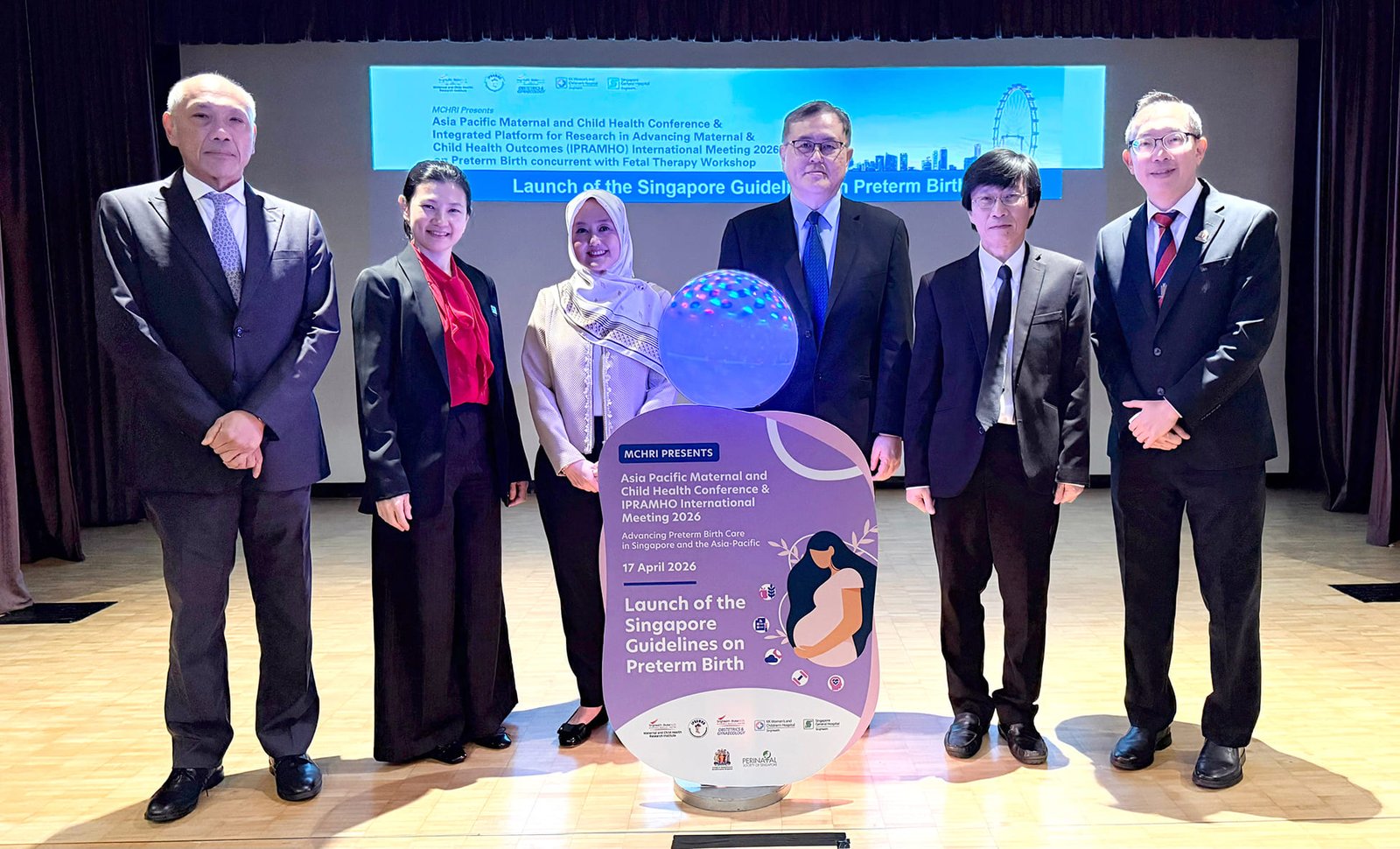
The new Guidelines were unveiled by Mdm Rahayu Mahzam, MOS, MDDI and MOH-2
KK Women's and Children's Hospital (KKH) and the College of Obstetricians and Gynaecologists (COGS) today launched the first comprehensive update to Singapore's Guidelines on the Management of Preterm Birth.
Unveiled by Mdm Rahayu Mahzam, Minister of State, Ministry of Digital Development and Information & Ministry of Health, the Guidelines standardise preterm birth screening, prevention and management to improve outcomes for mothers, babies and families.
Singapore’s preterm birth rate has remained consistently elevated at 8.5% – higher than other developed Asian neighbours like Hong Kong and China - for reasons that are not well understood.
Professor Teoh Tiong Ghee, Senior Consultant, Department of Maternal Fetal Medicine, KKH, said, “Preterm births affect close to 3,000 babies in Singapore every year. Premature infants often face a ‘marathon’ of health hurdles, including lifelong respiratory, neurological and developmental challenges that require intensive care and long-term specialist support. Beyond this, it also imposes substantial emotional and economic toil on the families.”
“We are moving the needle from reactive treatment to proactive prevention. Preterm birth has always been managed only from the final months of pregnancy. The Guidelines ensure that risk assessment starts from the very first pregnancy visit. By identifying vulnerable pregnancies in advance, we can intervene early, reduce the need for neonatal intensive care, and give every baby the best start in life.”
Every pregnancy matters: prevention from day one
Main highlights of the recommendations designed to identify and manage risks early include:
Structured risk assessment at key pregnancy milestones
Healthcare professionals are recommended to conduct formal risk screening at the first pregnancy visit and reassess at key milestones throughout the pregnancy - at 11 to 13 weeks, 18 to 22 weeks, and 24 weeks.
A history of previous preterm birth is the most obvious risk factor. However, this structured approach ensures that first-time mothers and women with previous full-term births are not overlooked. Other important risk factors also considered include cervical surgery, multiple pregnancies, or infections that could lead to preterm birth in any pregnancy.
Cervical length screening for pregnant women
Cervical length screening is recommended for pregnant women during second trimester checkups (18 to 22 weeks). This simple procedure uses an ultrasound to identify a “short” cervix – a primary indicator of preterm birth.
Women with a short cervix (≤ 25mm) may benefit from early interventions like progesterone therapy or cerclage (surgical stitches around the cervix) for high-risk cases, that can help to prolong the pregnancy.
The Guidelines recommend for cervical length screening to be implemented gradually over the coming years, to allow sufficient time for adoption into clinical practice.
Standard treatments to minimise early labour while protecting the baby’s brain
∙ Oral medication replaces intravenous (IV) treatment as first-line intervention
Nifedipine in oral tablet form has replaced the IV beta-agonists given through intravenous drips, offering a safer and more convenient way to stop or slow down preterm labour contractions. This change removes the need for monitoring and complex infusion protocols, whilst remaining equally effective at suppressing contractions.
∙ Fetal brain protection
Magnesium sulphate is recommended as standard treatment for pregnant women at risk of delivering babies between 24 and 32 weeks. This treatment administered to mothers before delivery can significantly reduce the risk of brain damage in their babies during the most vulnerable period of premature birth. This represents a shift from the earlier previous guidelines where the treatment was used sparingly due to safety concerns.
From evidence to action
A KKH study conducted earlier this year revealed a gap in patient knowledge of preterm births. The study, involving 115 pregnant women aged 21 to 45 years, revealed:
∙ 45% of the women were unaware of risk factors even though 87% have heard of preterm birth.
∙ 67% were unaware/unsure of preterm labour symptoms.
∙ 63% were unaware/unsure of the long-term implications.
Professor Tan Kok Hian, Head and Senior Consultant, Perinatal Audit and Epidemiology Unit, KKH, said, "The KKH findings show that pregnant women require more comprehensive guidance and support from healthcare professionals regarding preterm birth risks, symptoms, and consequences. The 2026 Guidelines provide healthcare professionals with internationally validated, evidence-based tools for enhanced preterm birth care. These proven interventions enable early identification of at-risk women and offer treatments that can significantly reduce the likelihood of preterm birth.”
The Guidelines were developed by a workgroup under COGS, comprising obstetricians and gynaecologists from Singapore's leading maternity hospitals – KKH, Singapore General Hospital, National University Hospital, Thomson Medical Centre, Mount Alvernia Hospital. The Guidelines were endorsed by the COGS and the Academy of Medicine, Singapore.
The Guidelines join other evidence-based resources tailored by the KKH Maternal and Child Health Research Institute specifically for the region's multi-ethnic Asian population. These resources cover gestational diabetes, perinatal nutrition and mental health, sexual health for women of reproductive age, menopause management, child health and development.